
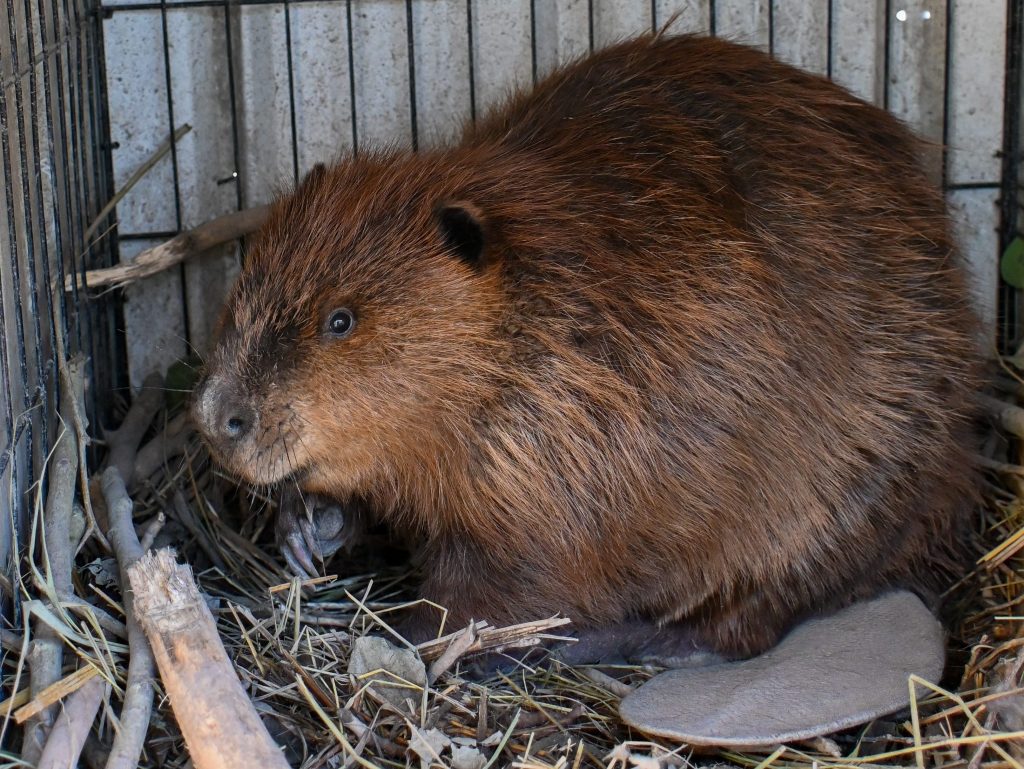
When the door of her enclosure swung open, Maggie the beaver wasted no time getting acquainted with her new home. After months of rehabilitation at the Interior Wildlife Rehabilitation Society, she finally returned to the wild. Maggie’s solitary rehabilitation journey was unusual because beavers typically live in pairs or in established colonies. “Normally, we would want to release beavers in opposite-sex pairs, or within their established colony, but Maggie was by herself when she was caught, so that was not possible,” said Jennifer Rogers, BCWF’s Beaver Restoration Assessment Lead.
Maggie was found alone in the wild in June, suffering from several open wounds. Recognizing her need for immediate care, wildlife biologist Tom Willms arranged to move her to the rehabilitation centre. “She was likely a young beaver in search of new habitat,” he said. “We set the live trap on June 28 and caught her that evening.” The BCWF took a keen interest in her rehabilitation because of the crucial role she could play in the restoration of wetlands. The Federation is building more than 100 structures across B.C. designed to mimic beaver dams, which provide flood protection and regulate stream flows on creeks.
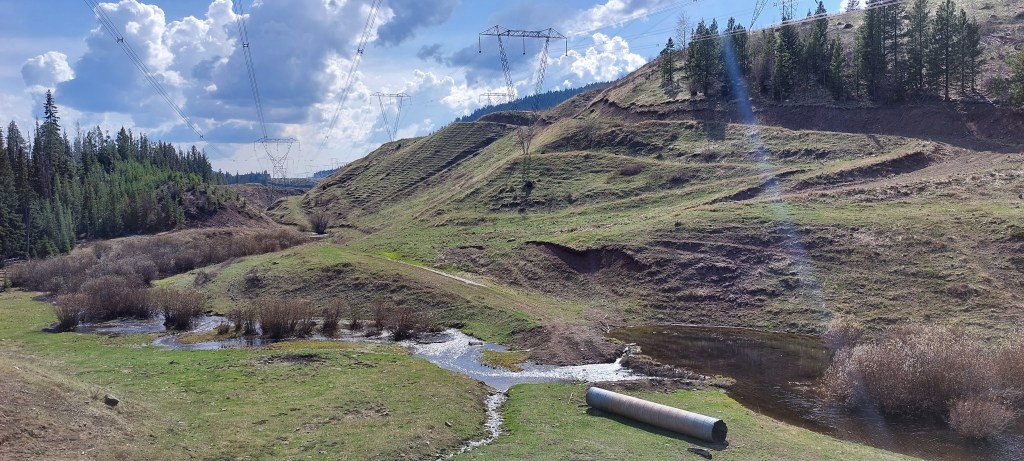
Previously regarded as a nuisance beaver in the community where she was found, Maggie’s return to the wild not only marks her triumph over adversity, but also an opportunity to create and maintain diverse and productive habitat at her new home. Upon leaving the IWRS centre, Maggie was transported by truck to join five beavers residing in her new home in Merritt. The area on Howarth Creek was already under the watchful eye of Willms, a professor at the Nicola Valley Institute of Technology.
The existing colony offered a perfect opportunity for Maggie to thrive in the wild. Both Rogers and Willms were on site to ensure Maggie’s smooth transition to her new home. Maggie was released in a pool formed behind a human-built Beaver Dam Analogue (BDA), constructed by Willms and a local First Nations contractor, Buck Machines. BDAs provide immediate deep-water habitat, offering protection from predators and supportive conditions for a beaver hoping to establish a home. This BDA construction project was a collaboration between the Nicola Research and Technical Committee, NVIT, the Nooaitch Indian Band, Fisheries and Oceans Canada (DFO), and the Fraser Basin Council (FBC), with funding provided through FBC.
To facilitate Maggie’s release, a temporary beaver lodge was constructed using nearby aspen branches. Bedding and sticks from Maggie’s home at the IWRS were placed inside to introduce a familiar scent and hopefully some comfort at the new site. The aspen trees used to build the beaver lodge also provide a supplementary food source for Maggie. In the Nicola Valley, water availability and storage are major concerns. Since wetlands act like a sponge, holding back water and slowly releasing it downstream, the natural barriers created by beavers provide a useful environmental service. By identifying signs of historic beaver occupation and bringing beavers back to these streams, Willms and the BCWF team hope to advance wetland restoration and enhance water storage in the region.


The hope is that Maggie will build on and improve the human-built BDAs, and along with the other beavers in her new colony, has indeed been a busy beaver, packing the BDA with mud and sticks, which allows it to hold back even more water. In the week after her release, the water level in the pond rose almost half a foot. The goal of the project is to have beavers take over and improve upon our BDAs since they are dam-building experts, and they certainly know how to hold back water. The presence of beaver colonies in a stream system helps to retain more water on land throughout the year and augments summer stream flows and enhances resilience to drought, flooding, and fire, which all affect the Nicola region. Partnering with beavers to manage watersheds reduces the need for municipal, regional, and provincial services, because beaver-based restoration is more efficient, cost-effective, and sustainable than built infrastructure. Maggie’s return to the wild represents a small step towards wetland resilience and water conservation.
This story, by Jamie Long (Conservation Stewardship Communications Coordinator), first appeared in the NOV/DEC 2023 issue of BC Outdoors Magazine in our member exclusive insert. Become a BCWF member today to get our news delivered directly to your mail box at bcwf.bc.ca/membership.
 BCWF Watershed Team
Leave a comment