
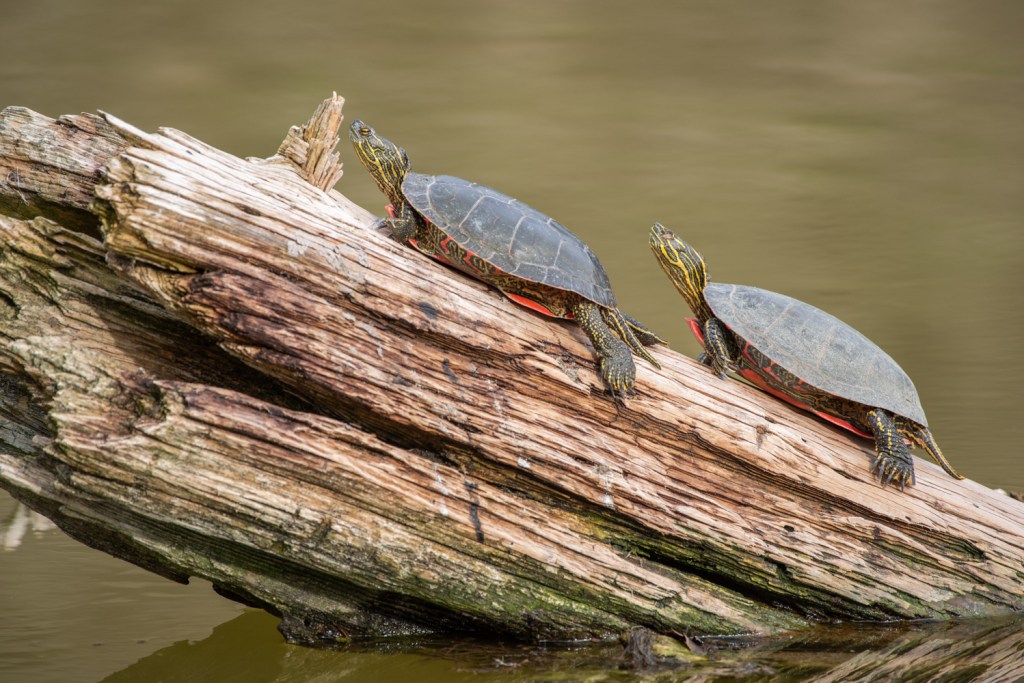
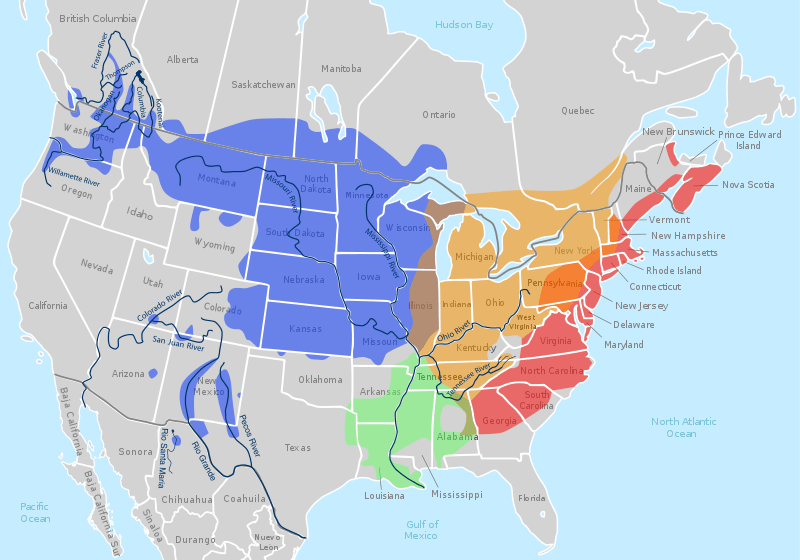
The painted turtle (Chrysemys picta) lives in relatively slow-moving fresh waters, with a large range across North America; in fact, it is the continent’s most widespread native turtle. During the last ice age, four subspecies evolved based on their regional distribution. The western painted turtle (Chrysemys picta bellii) can be found in British Columbia and is the largest of all the subspecies, growing up to 25 cm in length. Its range stretches as far east as Wisconsin, and loosely follows major rivers and their watersheds (as can be seen in the picture below).
The western painted turtle is physically different from the other subspecies. While the top-shell has a mesh-like pattern – a feature characteristic of painted turtles – the top stripe that is present in the other subspecies is missing or faint. Interestingly, its bottom shell is the most vibrant and is characterized by a large coloured splotch (that typically has red hues).
Its diet changes seasonally; something we should all aspire to do as well (the turtle must be more conscious of the environment). For example, in the summer months a majority of its diet consists of insects. When late summer and early fall approaches, however, that majority shifts to a plant-based diet. The western species is the only one of the four subspecies to eat in such a way.
Being a cold-blooded reptile, the painted turtle must regulate its internal body temperature (17 to 23 degrees Celsius) through the environment. Basking for warmth is typical, and despite our cold winter climate (where some of us decide to bask indoors, via tanning salons) the painted turtles fair well due to their ability to hibernate. What is notable is their manipulation of body temperature to an increase of (up to) 5 degrees Celsius when fighting infection.
The painted turtle has existed for an impressive 15 million years; given such a record, it must be abundant today! …Wrong. Well, sort of. The painted turtle remains abundant and is classified by the IUCN as a “Least Concern” species; however, within the Pacific Northwest its range is eroding. British Columbia marks its dwindling range, with turtles in the Coast region being labelled as “endangered” and those in the Interior labelled as “special concern”. What is a major factor for the loss of western painted turtles in the Pacific Northwest? The answer: wetlands. The drying of wetlands has reduced the amount of hospitable areas for western painted turtles, and has promoted increased predator traffic and/or increased human traffic.
 BCWF Watershed Team
Leave a comment