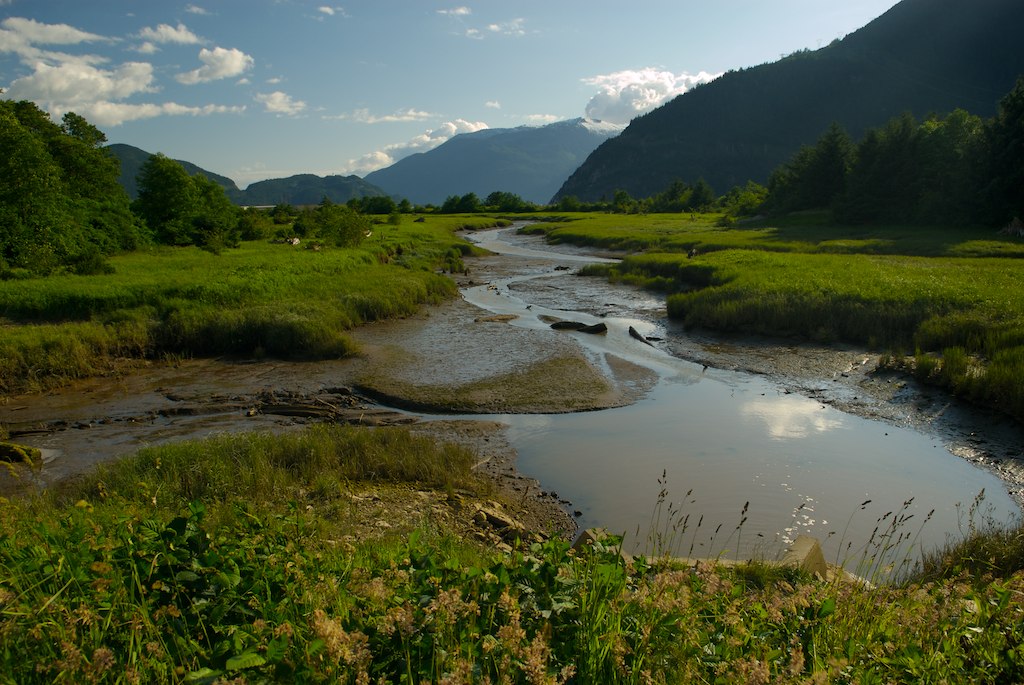
On Wednesday, July 11, 2012, the BC Wildlife Federation’s Wetlands Education Program hosted a one-day workshop in Squamish targeting municipal planners from B.C. The workshop’s main objective was to inform planners on ways they can incorporate wetland stewardship into their policies, while also presenting an overview of the value of wetlands and their basic functions. Water is a vital resource, and regional and municipal plans must manage and regulate it sustainably. As a society, we are recognizing the growing importance and benefits of wetlands, such as flood control, water filtration, and the provision of habitat for thousands of species — services which are provided for free.
The workshop featured four speakers from different organizations and 19 planners from the Lower Mainland and surrounding areas. The speakers were chosen because each had made significant contributions to protecting wetlands and were enthusiastic about providing tools and information for other communities to follow in their footsteps.
The first speakers were Kyle Hawes (Ecoscape Environmental Consultants Ltd.) and Greg Sauer (Municipal Planner) from the City of Kelowna. Hawes and Sauer’s presentation highlighted the importance of bringing municipal planners into the same room to learn from each other’s decision-making successes and challenges. The City recently developed a comprehensive wetland protection plan through public consultation, wetland inventory, assessment, and mapping, which is shaping up to be one of the best in the province. The Wetland Inventory, Classification, Evaluation, and Mapping (WIM) was completed in 2009 with funding from the Okanagan Basin Water Board and Ducks Unlimited. Among the most important accomplishments is the establishment of a minimum 15-metre setback that applies to non-fish-bearing water bodies (fish-bearing = 30 metres). These areas serve as buffers from development to mitigate and reduce potential impacts on streams, preserving the functionality, biodiversity, and connectivity of a watershed.
The next presentation was given by Jack Minard, Executive Director of the Tsolum River Restoration Society and the Comox Valley Land Trust. Minard represents the Comox Valley Conservation Strategy, a group of over 20 organizations dedicated to environmental protection. All local governments in the Comox Valley region have endorsed their publication, Nature Without Borders, a science-based framework for land use specific to the Valley. The Strategy has achieved a 30-metre buffer on sensitive ecosystems — weaving a thread of wetland protection around the valley and maintaining connectivity, which is key for biodiversity resilience on the landscape.
The last speaker, Deborah Carlson from West Coast Environmental Law, brought to the table an insider perspective on the legislative and political workings that apply to wetlands in B.C. Basing her presentation on the Green Bylaws Toolkit, Carlson outlined bylaws and tools that local governments in B.C. are using to protect sensitive ecosystems, including a discussion on benefits and drawbacks. This informative presentation provided context on the status of environmental legislation in Canada.
After lunch, participants split into two groups to discuss and expand on the main points raised by the speakers. Both groups discussed wetland protection — one focusing on politics and legislation, the other on biophysical and resource inventory techniques. The breakout session lasted for more than two hours and produced substantial dialogue and engagement among the planners. The groups had a great dynamic: a planner would introduce an idea or tool, another would expand and build on it until it was fully developed, effectively filling in knowledge gaps. One municipal planner noted:
There were a number of key points that surfaced during the two breakout groups. In the politics and legislation group, planners discussed the need for a toolkit that can not only help identify available protocols to monitor compliance but also measure the effectiveness of policies and regulations on watershed integrity, arguably the largest hurdle in conserving wetlands (and other sensitive ecosystems) in areas where they are protected in principle. Some municipalities have protection bylaws around wetlands, but how do we know if those measures are enough? Could we be suffering from “death by a thousand cuts”? For instance, are pre-established guidelines around setbacks sufficiently protecting stream health and ecological integrity? What about unprotected or underprotected waterways and headwaters? One way a toolkit could improve this kind of decision-making is by establishing the watershed as the principal management unit, not a political jurisdiction (as discussed as a concept in Nature Without Borders).
In the biophysical and resource inventory techniques group, planners discussed the importance of municipalities being able to identify and map small wetlands. Limited funding appeared to be the number one barrier associated with wetland mapping, as smaller wetlands are difficult to map using orthophotos because they either do not appear or are obstructed by forest canopy cover. Therefore, mapping has to occur on the ground, which is labour-intensive and often expensive. Suggestions for future solutions to these barriers were discussed in great detail and focused on how municipalities could receive more funding for mapping wetlands if they began using wetland protection as a justification for improving water quality, providing better stormwater management, or mitigating the effects of climate change. Additionally, GPS/GIS mapping of wetlands could serve as an excellent base system mapping that could eventually be included with future municipal mapping of drainage or stormwater plans.
The workshop was part of a larger 8 day Institute on the Sea-to-Sky Corridor. It would not have been possible without the financial support of: Habitat Conservation Trust Foundation, Government of British Columbia, Government of Canada, Wildlife Habitat Canada, Environment Canada, Shell, and the Canadian Wildlife Federation. Stay tuned for the full report on the BCWF’s website (including more on the presentations and discussion groups)!

 BCWF Watershed Team
Leave a reply to Stewards of the Sea-to-Sky — Wetlands Institute 2012 – BCWF Watershed Team Cancel reply