For the first time, BCIT Master of Ecological Restoration students took instruction in beaver-inspired wetland restoration techniques with the goal of combating escalating droughts, floods, and wildfires.
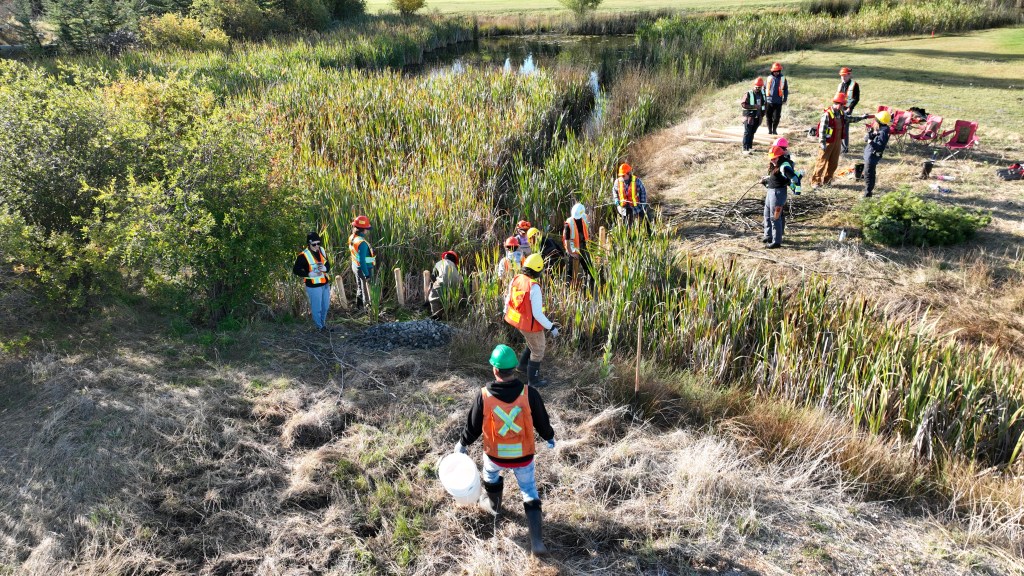
BCIT alumna and the B.C. Wildlife Federation’s Beaver Restoration Assessment Lead, Jen Rogers, led the new beaver-inspired workshops at Logan Lake last September. The BCIT training session included training in the construction of human-made beaver dam analogues (BDAs), which included a demonstration dam on the Logan Lake Golf Course.
The BDA built for the session is the first dam built as part of the 10,000 Wetlands project a three-year BCWF project that aims to build more than 100 BDAs across British Columbia. The dam was built for instructional purposes, rather than habitat for beavers, which typically aren’t welcome on golf courses.
Students collaborated on a groundwater wetland project adjacent to the golf course, noteworthy because golf courses are often associated with a high environmental impact. The project is the latest in a series of local initiatives designed to enhance water filtration and improve water quality around the lake.
The wetland design incorporates varying depths to provide preferred habitat for amphibians, ducks, and invertebrates. Tree branches were installed to attract birds of prey.
In the beaver-based restoration sessions, students learned the techniques required to build a functional BDA and the ways that beaver dams can provide useful services, such as regulating water flow to mitigate the effects of drought and extreme precipitation.
Construction of the BDA on the Logan Lake Golf Course is a collaboration between the BCWF, BCIT students, and Land Guardians from neighboring First Nations, including the Stswecem’c Xget’tem First Nation, the Upper Nicola Indian Band, and the Nooiatch Indian Band.
Workshop students appreciated the novelty and the practicality of BDA design and construction.
“Constructing a beaver dam analogue under BCWF’s direction was eye-opening,” said Cammie Good, a second-year student in the ecological restoration master’s program at BCIT and SFU. “As a new technique being introduced to B.C., hands-on training from leading field experts was invaluable.”
“Over a decade ago, we embarked on this journey with (BCWF’s) Wetlands Institute in Kamloops in June 2010,” said biologist Marge Sidney, a former employee of the Ministry of Environment. “Recognizing Logan Lake’s water quality challenges, we launched our first wetland project near the golf course in 2011.”
The Water Water Everywhere Initiative intends to reintroduce beavers to regions where they once flourished. BDAs enhance climate resilience by providing natural protection from floods, fires, and droughts by trapping and gradually releasing water. Functioning BDAs enhance water preservation and floodplain connectivity, creating rich habitats for a diverse array of wildlife. The Logan Lake beaver dam is proving to be the first of many successes.
After the BCIT annual wetland workshop in Logan Lake, students departed with insights, ideas, and practical training to take into their professional lives. In collaboration with First Nations and local communities throughout British Columbia, BCWF hopes these students will play a key role in ecosystem restoration and climate change mitigation for generations.
This story, by Jamie Long (Conservation Stewardship Communications Coordinator), first appeared in the MAR/APR 2024 issue of BC Outdoors Magazine in our member exclusive insert. Become a BCWF member today to get our news delivered directly to your mail box at bcwf.bc.ca/membership.
 BCWF Watershed Team
Leave a comment