After many years of planning, work is finally underway to restore Ginty’s Pond to an open-water ecosystem. An essential wetland habitat in the B.C. Interior, restoration efforts at this site will help protect several federally listed species at risk, including the yellow-breasted chat (Icteria virens), western screech-owl (Megascops kennicottii), Great Basin gophersnake (Pituophis catenifer deserticola), Great Basin spadefoot (Spea intermontana), and western painted turtle (Chrysemys picta bellii).
Although this unique oxbow wetland was visibly cut off from the Similkameen River due to diking, it remained hydrologically connected to the river via the underground water table. Restoration efforts at the site will not only support B.C.’s native species and biodiversity, but also create opportunities for community members to engage in future habitat enhancements.
“Many locals can still remember skating on the frozen pond in winter and kayaking during the summer,” said Cassie Friesen, Wetlands Workforce Southwest Pod Field Crew Supervisor. “This project will bring back those opportunities, allowing the community to reconnect with nature.”
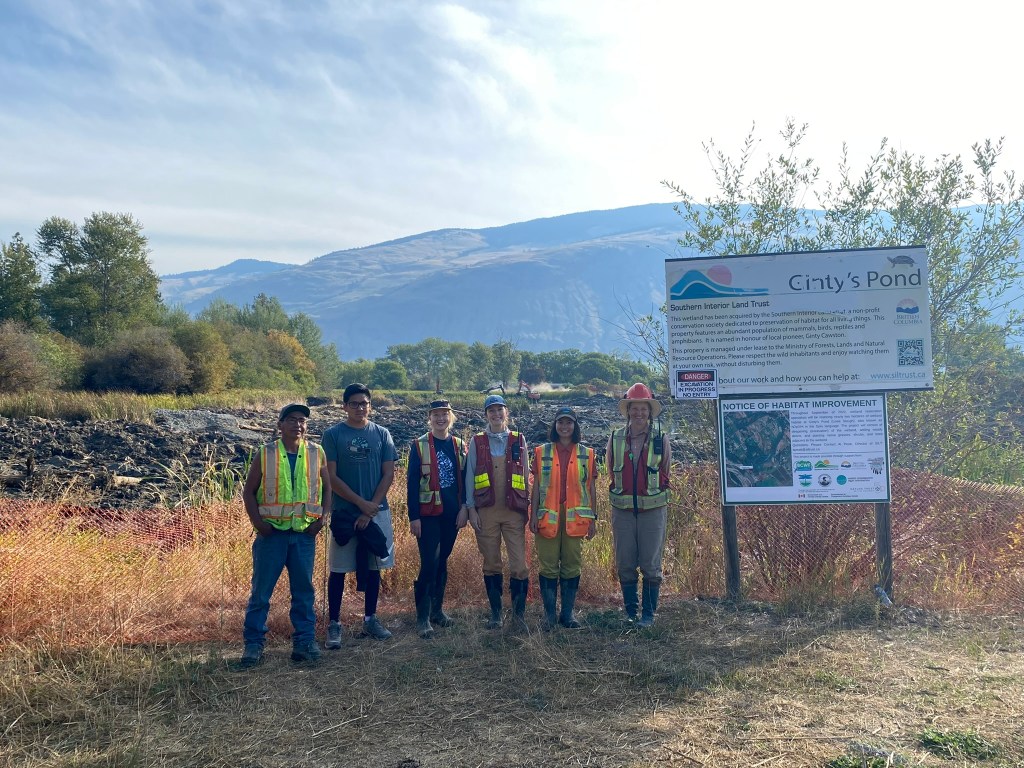
This past September, the Southern Interior Land Trust (SILT) worked in collaboration with the Lower Similkameen Indian Band (LSIB), the Nature Trust of British Columbia, the B.C. Wildlife Federation’s Wetlands Workforce, and the Province of British Columbia to restore 1.2 hectares of open-water wetland habitat and 0.5 hectares of new riparian woodland-shrub habitat.
In addition to pool enhancements, collaborators and volunteers contributed to ongoing site maintenance and monitoring to support this important habitat. Youth from Keremeos Secondary School visited the site in September to disperse native milkweed seeds and add small woody debris. In October, 40 Grade 8 students from Similkameen Elementary Secondary School installed 150 native plants, with an additional 650 plants installed by project collaborators.
A key component of the Ginty’s Pond restoration involved controlling cattail (Typha spp.) encroachment. Jessie Spence, Wetlands Workforce Southwest Pod Field Crew Supervisor, highlighted the importance of this work:
“Cattail marshes can be beneficial ecosystems on the landscape, but oxbow wetlands like Ginty’s Pond are rare. There’s a lot of value in restoring the pond and opening it back up to create a shallow, open-water ecosystem. This enhances diversity in both the plant community and the habitat available to local wildlife.”
Restoring Ginty’s Pond is an ongoing effort that will continue over the coming seasons and years. Upcoming activities include removing invasive species in the spring before they flower and set seed, installing a wildlife camera and hydro pole, and monitoring wildlife use—such as recording egg masses of Columbia spotted frogs (Rana luteiventris) and Great Basin spadefoots, as well as observing nesting activity of the western painted turtle.
Thank you to the following funders for supporting this project: Environment and Climate Change Canada, Habitat Conservation Trust Foundation, Nature Trust of British Columbia, Province of British Columbia, and the Canadian Wildlife Service.
 BCWF Watershed Team
Leave a comment