This past autumn, the BC Wildlife Federation (BCWF) had the unique opportunity to provide additional support at two previously restored wetlands and assist with the construction of a new wetland complex. On a whirlwind journey of close to 2,500 km, the Wetlands Education Program (WEP) team, along with two volunteer interns from the Canadian Wildlife Federation’s Canadian Conservation Corps, embarked on a restoration blitz through the Kootenays. Over the course of three weeks, the WEP team planted over 3,500 shrubs and juvenile trees, aiming to enhance habitat for wildlife. This work was completed at the tail end of the field season, racing against time before winter weather set in.
The restoration blitz began with a collaborative planting day at Earl Ranch, a 208-hectare property purchased by the provincial government in 1974. Several wetlands were restored on this property in 2018 to provide ungulates in the area with a reliable source of food during the winter. Together with eight colleagues from the Ministry of Forests, BC Parks, and the Ministry of Water, Land, and Resource Stewardship, we planted 2,200 shrubs in the riparian zones surrounding the wetlands. This opportunity allowed us not only to supplement the natural regrowth of native plants but also to observe clear evidence of wildlife using the site—a herd of elk quickly departed upon our arrival, and tracks of ungulates and waterfowl were prominent on-site.
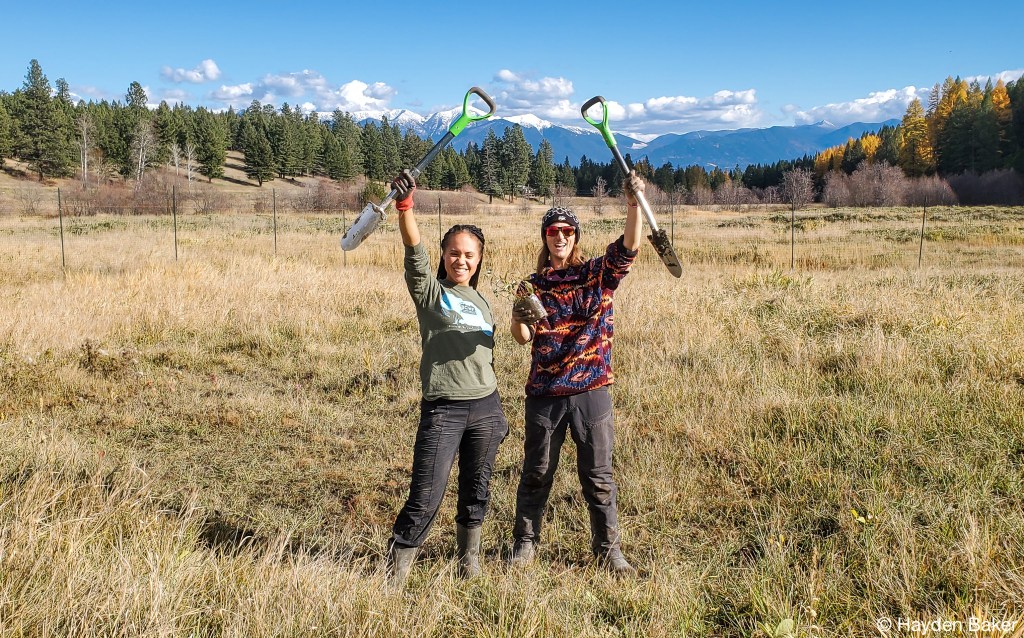
Revisiting previous restoration sites in a maintenance capacity also helped us strengthen our relationships with project partners by collaboratively enhancing this habitat. The planting day was a complete success, and with the sun warming our cheeks, we couldn’t help but raise our planting shovels in recognition of the great work we all accomplished.
The next stop on this whirlwind tour was Sparrowhawk Farm, a scenic private property just outside of Kimberley, B.C. With the snow-capped Rocky Mountains as our backdrop, we began a five-day restoration project that quickly became challenging due to frigid winter conditions, with temperatures dipping down to -21°C. This presented unique challenges, including frozen ground, a near white-out as a short-lived snow system moved through the valley, and one incident where a team member fell through the ice into one of the wetlands. Fortunately, our team member was unharmed and was able to get warm and dry quickly.
Despite these challenges, we did not let any events sidetrack us; a key aspect of wetland restoration is seeing the project through on time and in all types of weather conditions. Even though we often ended the day with frozen toes and aching limbs, we relished the knowledge that our part in the restoration work was necessary for its success.

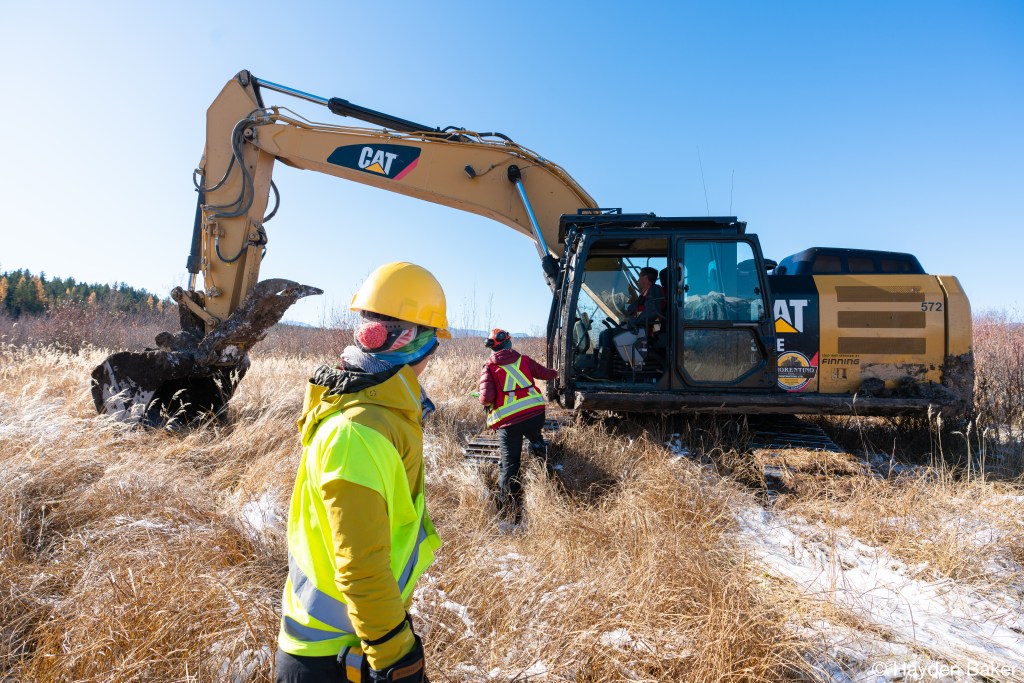
The project at Sparrowhawk Farm started on October 28, using two excavators and one bulldozer to create six wetlands. As assistants to the on-site Restoration Specialist Robin Annschild, our main tasks were to map the new wetlands and gather additional GPS data on the wetlands restored the previous year. Mapping is an incredibly useful tool that can be used as a metric to visualize the extent of the newly created wetlands, measure the total area restored, outline the areas seeded to prevent the growth of invasive species, and note key features. This data will then be used to generate maps providing a bird’s-eye view of the completed work.
The last few days were dedicated to planting willow and red-osier dogwood stakes (live cuttings taken from shrubs on-site) along the edges of the new wetlands and seeding the riparian zones with native sedges and grasses. The staking was incredibly difficult, as the ground was mostly frozen solid—another example of racing the clock with Mother Nature. Thankfully, we were able to use one of the excavators to plant large stakes made from a black cottonwood limb that had recently fallen from a tree; we removed the smaller branches (to be planted as well) and then had the excavator push them into the frozen ground. Planting native species directly after wetland completion adds stability to the riparian soils and discourages the growth of invasive species that could otherwise overrun the site.
We were able to convey the objectives of the project and the ecological value of restoring these highly functional habitats, which was enlightening for the curious community members. They gave us their full support and left with a greater understanding of the importance of wetlands for biodiversity and mitigating the adverse impacts of climate change.
Both properties featured wetland complexes restored several years ago. While they were already established and thriving ecosystems, our goal was to enhance the restoration activities by suppressing invasive plant species.
 BCWF Watershed Team
Leave a comment