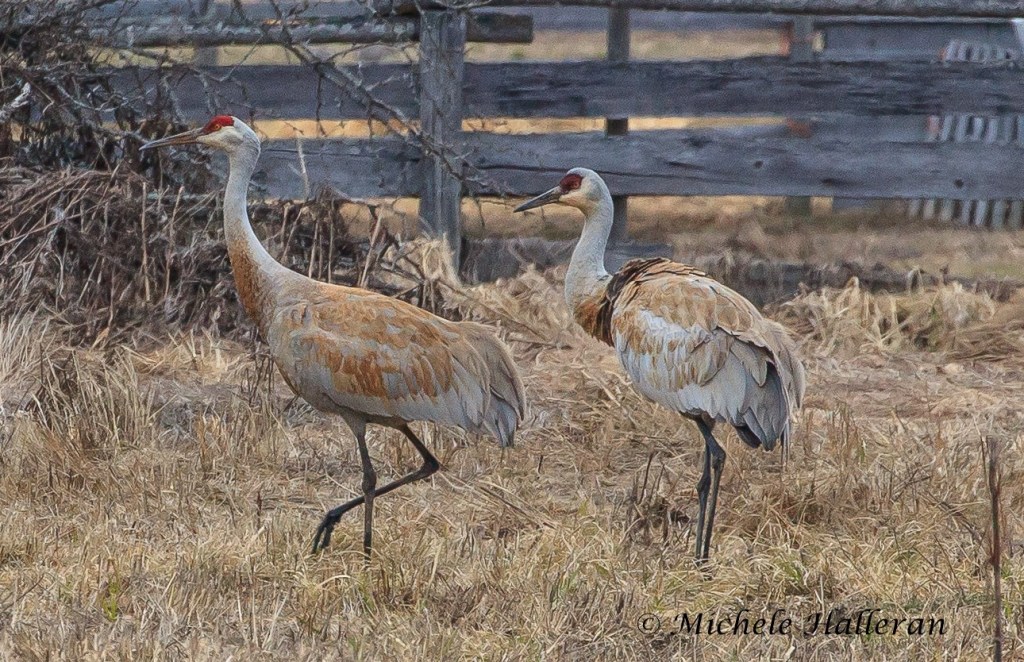
Today the BCWF’s Wetlands Education Program (WEP) team is celebrating a big win! A restoration project completed in Meadow Creek, in the Lardeau Valley at the north end of Kootenay Lake, is now home to a family of sandhill cranes (Antigone canadensis), a species listed as vulnerable by the Province of British Columbia. The final phase of this project was completed in the spring of 2016.
The area serves as an important corridor for elk (Cervus canadensis) and grizzly bear (Ursus arctos horribilis), and provides critical habitat for many wetland-associated species, such as the Western Toad (Anaxyrus boreas), Bobolink (Dolichonyx oryzivorus), and now, most notably, the Sandhill Crane! This marks the first time sandhill cranes have ever been observed in this part of the region, highlighting just how impactful wetland restoration work can be!
The WEP team has been involved in numerous restoration projects across the province. In 2017 alone, the team completed 7 restoration projects, resulting in 9.75 hectares of restored land. Each year the capacity for restoration work increases, and we are very hopeful to keep this momentum running throughout 2018.
Habitat restoration is an extremely important piece to wetland conservation and overall ecosystem health. From maintaining water flow during flood and droughts, to providing critical habitat for many plants and animals, wetlands offer a tremendous amount of different functions that benefit the planet. They are often known as “the kidneys of the Earth”, based on their incredible ability to clean and filter water as it flows through them. Not to mention B.C.’s wetlands are worth over $100 billion/year!
If that isn’t a reason to conserve wetlands, then I don’t know what is.
The WEP team is dedicated to continuing to conserve wetlands through restoration and education projects throughout the province. If you are interested in learning more about the programs that we offer, please click here.
Thank you to Michele Halleran, property owner of the restoration site, for the beautiful photos. Additionally, a special thanks to our funders: Fish and Wildlife Compensation Program, Wildlife Habitat Canada, and Environment and Climate Change Canada, for making this project a reality.
 BCWF Watershed Team
Leave a comment