
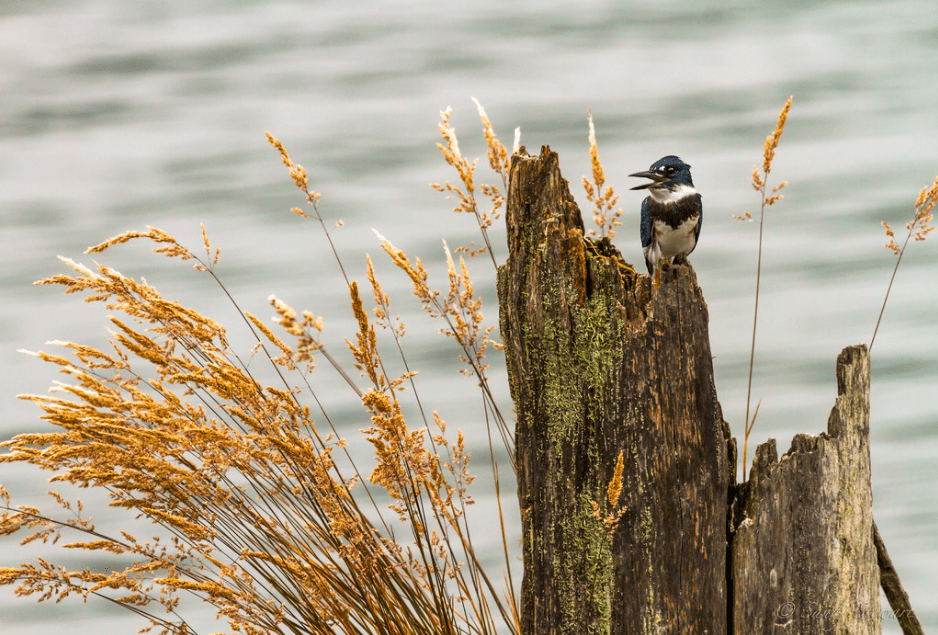
The Belted Kingfisher (Megaceryle alcyon) is a medium-sized bird commonly found near rivers, lakes, estuaries, and wetlands across North America. Ranging from 28 to 30 cm in height, with a wingspan of 48 to 58 cm, this striking species is known for its shaggy crest, sharp dagger-like bill, and loud, mechanical rattle call.
Its plumage is a vibrant slate blue on the head, back, and wings, contrasted by a white underside and collar. The species is sexually dimorphic, with males displaying a single broad blue band across the chest, while females have an additional rusty band below the blue one—making it one of the few bird species in which the female is more brightly coloured than the male.
Belted Kingfishers are often seen perched near water, scanning for prey. They hunt by hovering mid-air with their bills pointed downward before diving head-first to catch fish. Their diet consists primarily of small fish, but they also feed on amphibians, crustaceans, aquatic insects, small reptiles, and occasionally small mammals. Remarkably, they’ve even been observed diving into water to avoid predators such as hawks.
This species breeds across most of Canada and Alaska, extending as far south as Central America. In British Columbia, they are common summer residents and may be found year-round in coastal regions. Breeding habitat includes areas with soft, silty banks where they can excavate nesting burrows near water. These burrows often slant upwards, helping create an air pocket that protects the chicks from flooding.
Both male and female Belted Kingfishers take part in digging the burrow, incubating the 5–8 eggs, and feeding the young once they hatch. Nesting burrows can reach over a metre in length, often dug into riverbanks, road cuts, or sand cliffs adjacent to water bodies.
Keep an ear out for their distinctive call and an eye on streamside perches—Belted Kingfishers are excellent indicators of healthy freshwater and wetland ecosystems.
For more information and multimedia on this species, visit The Cornell Lab of Ornithology.
 BCWF Watershed Team
Leave a comment