
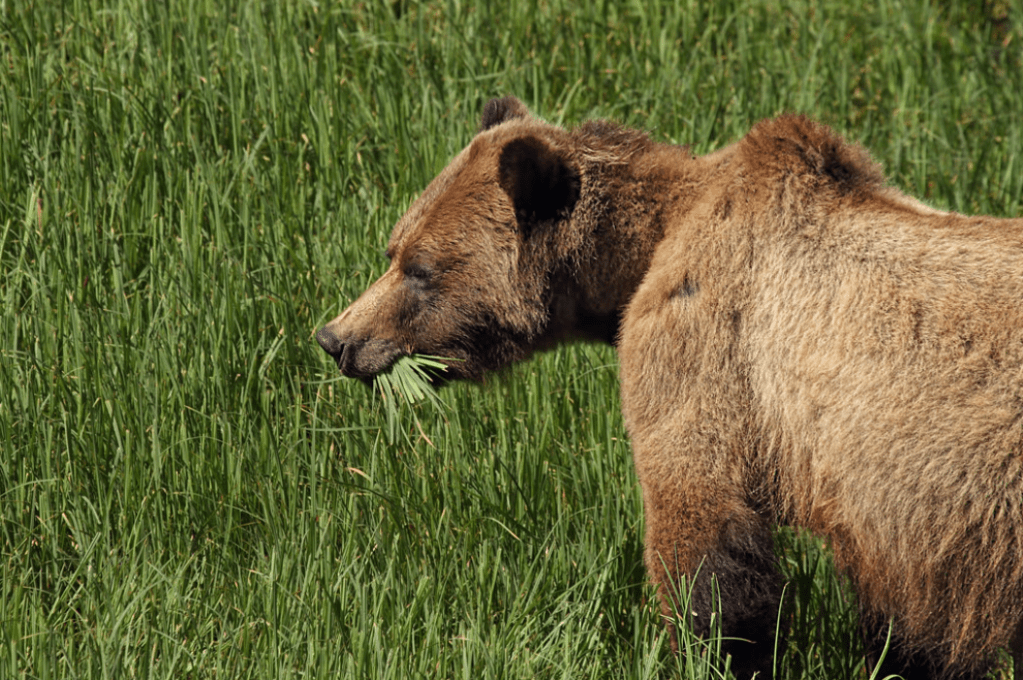
Grizzly bears are one of British Columbia’s most iconic and ecologically vital species.
These powerful mammals are a subspecies of the brown bear. While both are part of the same species (Ursus arctos), grizzly bears are specifically known as Ursus arctos horribilis. In other words, all grizzlies are brown bears, but not all brown bears are grizzlies.
Grizzlies are easily recognized by their large size, muscular shoulder hump, concave facial profile, short rounded ears, and long front claws—often up to 13 cm in length. Their coats range from pale blonde to dark brown or nearly black and often appear “grizzled” due to light-tipped hairs.
Though they’re famously associated with salmon, especially in coastal regions, vegetation actually makes up the bulk of a grizzly’s diet. They consume grasses, roots, berries, sedges, and insects, adjusting their diet throughout the seasons. Coastal bears can weigh up to 1,000 pounds, thanks in part to seasonal access to salmon.
One important wetland plant in their diet is Lyngbye’s Sedge (Carex lyngbyei), found in Pacific Northwest estuaries—where salt and freshwater mix. These rich ecosystems offer food and cover not just for bears, but also for juvenile salmon, who both shelter among and feed on the same sedge.
Grizzlies are found throughout much of British Columbia, occupying about 90% of their historic range in the province, though they are absent from Vancouver Island, the Lower Mainland, and portions of the southern interior. B.C. is home to roughly 15,000 grizzly bears—about 25% of North America’s total population.
A shining example of grizzly conservation is the Khutzeymateen Grizzly Bear Sanctuary, located northeast of Prince Rupert. This 45,000-hectare protected area includes coastal rainforest, river estuary, and fjord coastline, and supports around 50 grizzly bears. The sanctuary was established specifically to protect grizzlies and their critical habitat.
Grizzly bears have one of the lowest reproductive rates of any North American land mammal. Females typically mature between 5 and 8 years of age and produce an average of two cubs every two to three years. Cubs are born in the den during winter hibernation and may remain with their mother for up to three years. Mortality among cubs is high—up to 70% die before reaching reproductive age. Major threats include starvation, predation by adult male bears, and human-caused habitat disturbance.
Dens are typically dug on snow-covered, north-facing slopes, where bears hibernate for four to six months depending on the region. In the wild, grizzlies can live up to 25 years.
As a keystone species, grizzlies play a vital role in shaping ecosystems. Their foraging behavior—digging, moving soil, carrying salmon into forests—helps distribute nutrients across landscapes and supports the health of plant and animal communities far beyond where they roam.
In Canada, the Committee on the Status of Endangered Wildlife in Canada (COSEWIC) lists the grizzly bear as a species of Special Concern due to habitat fragmentation, slow reproductive rates, and increasing pressure from human activity.
References
- BC Parks – Khutzeymateen Provincial Park
- Bears in B.C.
- Government of B.C. – Grizzly Bear Information
- WildSafeBC – Grizzly Bear Species Page
- Hilderbrand, G. V., et al. (1999). Role of Brown Bears in Nutrient Transfer. Oecologia, 121(4), 546–550.
 BCWF Watershed Team
Leave a comment