
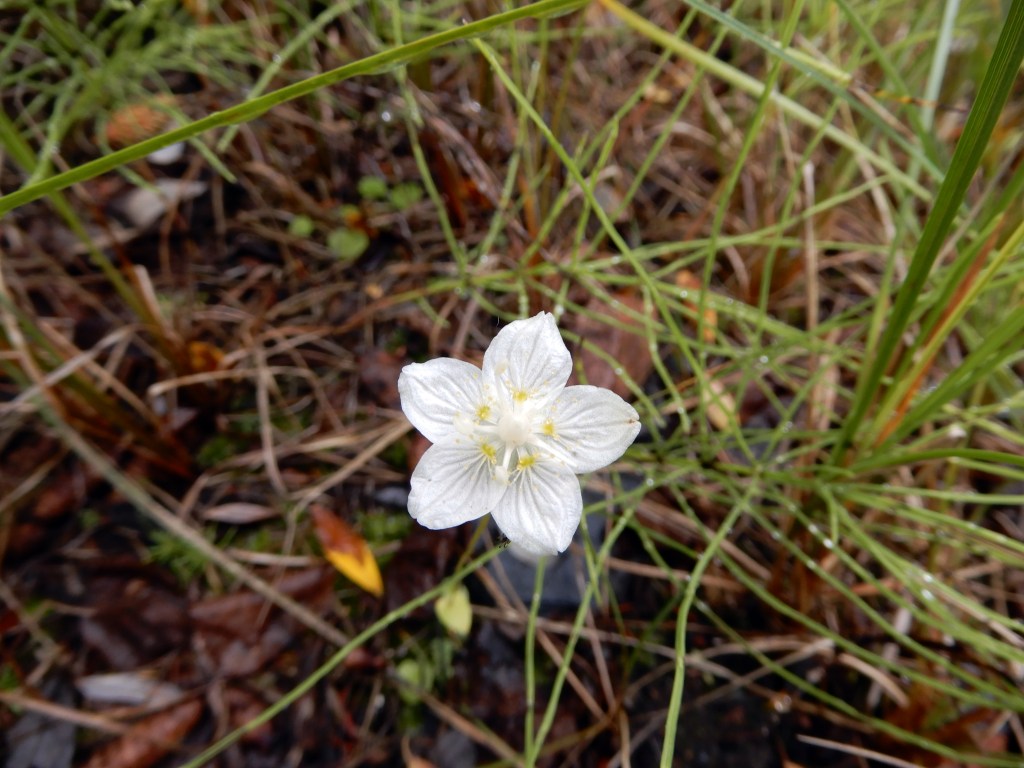
With its bright, star-like white petals standing out against the darker greens and browns of wetland groundcover, the Northern Grass-of-Parnassus (Parnassia palustris)—commonly called the Bog Star—is a striking and unmistakable wetland plant. Its five radiant petals sit atop a solitary upright stem, with most foliage concentrated at the base, creating a simple yet elegant bloom that is easy to recognize.
This species is most commonly observed in bloom from July through September. It can be found in a variety of wetland habitats, including fens, marshes, wet meadows, moorlands, streambanks, shores, and raised bogs—extending even into the alpine zone.
The species name palustris translates from Latin as “of the marsh” or “boggy,” reinforcing its status as a true wetland resident. In British Columbia, four native varieties of Parnassia can be found, all of which favour wet ground. One such variety, Parnassia fimbriata, is more common in northern B.C. and the Rocky Mountains and is distinguished by its beautiful fringed petals.
Northern Grass-of-Parnassus is a circumboreal species, meaning it is found throughout the northern latitudes of the globe, particularly within the boreal forest belt. In B.C., its range extends across the north and into the eastern interior, including the Kootenay region and areas near the Yukon and Alaska borders. It thrives in remote and undisturbed wetland habitats, such as those found near the Liard River—a major waterway whose headwaters begin in the Yukon and travel across northern B.C. before draining into the Northwest Territories.
This delicate plant is not only a visual highlight of northern wetland landscapes, but also serves as a reminder of the unique biodiversity and ecological importance of these habitats. As wetland conservation becomes increasingly critical, recognizing and protecting the plant communities within them is essential.
 BCWF Watershed Team
Leave a comment