
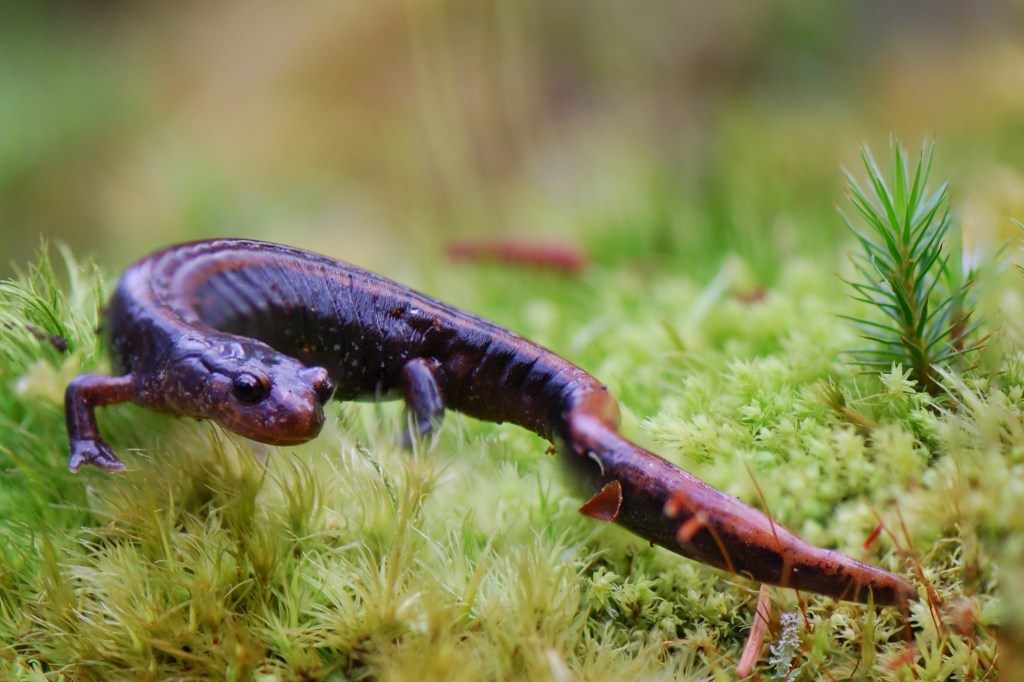
Camouflaged among dead leaves and humus, the Western Red-backed Salamander (Plethodon vehiculum) is perfectly suited to the shaded, damp environments of British Columbia’s forests. Its rusty dorsal stripe blends seamlessly into the forest floor, making it a challenge to spot unless you’re looking closely.
This small terrestrial amphibian ranges from B.C. to southern Oregon and prefers Douglas Fir and other conifer-lined riparian areas. Unlike many other salamanders, the Western Red-backed Salamander does not have an aquatic larval stage. Instead, it lays its eggs in moist terrestrial environments and bypasses the typical gilled, aquatic juvenile phase—reducing competition with more water-dependent amphibians.
Commonly found under rocks or rotting logs along stream banks or in forested wetlands, this salamander is active in cool, damp conditions. Remarkably, it can be found in both mature and young forests—making it one of the few Pacific Northwest salamanders tolerant of early-successional forest habitats. Individuals are highly site-faithful, with a home range that often spans only a few square meters.
There are nine native salamander species in British Columbia, and the Western Red-backed can be distinguished by the red or yellow stripe running down its back, often paired with subtle white speckling on the sides of its head—perfect camouflage for the forest floor. Mating typically occurs in the fall, and tiny, fully formed hatchlings can often be observed later in the same season.
While this species is not currently at risk and may be found in groups beneath a single log, its habitat remains vulnerable. Ephemeral wetlands, stream banks, and forested areas are under pressure from development, logging, and climate change. As with all amphibians, the Western Red-backed Salamander is highly sensitive to environmental changes—its skin is permeable and absorbs chemicals and pollutants from its surroundings, making it particularly vulnerable to habitat degradation.
Ecologically, this salamander plays a vital role in forest and wetland food webs. It preys on invertebrates, snails, Pacific Tree Frogs, and Red-legged Frog tadpoles, while serving as a food source for Garter Snakes, Shrew Moles, American Dippers, and Carabid Beetles. The loss or decline of this species could have cascading effects through the ecosystem.
Protecting forested wetland edges and maintaining healthy riparian corridors is essential for sustaining this species and the many others connected to its habitat.
 BCWF Watershed Team
Leave a comment