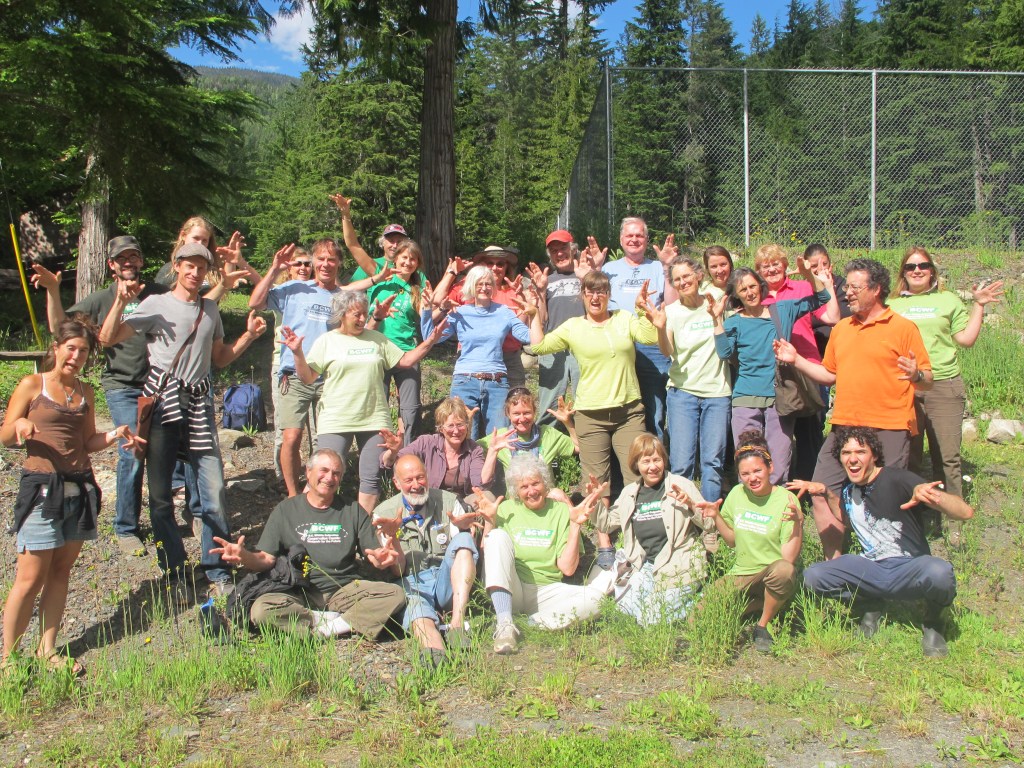
It’s always a privilege to learn from passionate biologists—and we were incredibly fortunate to have nine of them attend our Wetlandkeepers course in New Denver! The Slocan Valley has been identified as a priority area by the Fish & Wildlife Compensation Program’s Riparian & Wetland Action Plan, making it an ideal location to host this course and encourage wetland stewardship.
Held June 7–9, the workshop coincided with the BCWF Wetlands Program’s very first BioBlitz—an intensive biological survey that attempts to record all living species in an area within a set time frame (ours spanned 2.5 days). The New Denver BioBlitz successfully recorded over 150 species at Hunter Siding Wetland and Bonanza Marsh, with experts in botany, ornithology, entomology, herpetology, GIS, chiropterology, lepidopterology, and limnology all contributing.
The 25 full-time participants included members of the Slocan Lake Stewardship Society, the Slocan Lake Research Centre, Slocan River Streamkeepers, naturalists, students, and citizen science enthusiasts. The weekend was filled with knowledge-sharing and hands-on experience—an exciting step forward for watershed conservation in the Slocan Valley.
Birds – Led by Janice Arndt
Ornithology (Greek ornis – “bird”)
Participants joined Janice Arndt early Saturday for auditory bird sampling at Hunter Siding Wetland. Using a 5-minute interval protocol, participants trained their ears to detect and identify wetland bird species. Janice is piloting a marsh bird monitoring protocol similar to the Great Lakes Marsh Monitoring Program in Ontario, under support from Environment and Climate Change Canada.
Bird Species Observed (Hunter Siding Wetland):
- Common Yellowthroat (Geothlypis trichas)
- Hammond’s Flycatcher (Empidonax hammondii)
- MacGillivray’s Warbler (Geothlypis tolmiei)
- Yellow Warbler (Setophaga petechia)
- Song Sparrow (Melospiza melodia)
- Warbling Vireo (Vireo gilvus)
- Veery (Catharus fuscescens)
- American Redstart (Setophaga ruticilla)
- Cedar Waxwing (Bombycilla cedrorum)
- Gray Catbird (Dumetella carolinensis)
- American Robin (Turdus migratorius)
- Northern Waterthrush (Parkesia noveboracensis)
- Tree Swallow (Tachycineta bicolor)
- Black-headed Grosbeak (Pheucticus melanocephalus)
- Western Wood Pewee (Contopus sordidulus)
- Swainson’s Thrush (Catharus ustulatus)
- Red-winged Blackbird (Agelaius phoeniceus)
- Marsh Wren (Cistothorus palustris)
- Lincoln’s Sparrow (Melospiza lincolnii)
- Eastern Kingbird (Tyrannus tyrannus)


Butterflies & Moths – Janice Arndt
Lepidopterology (Greek lepido – “scale” + pteron – “wing”)
Despite rainy weather, participants identified multiple butterfly species. Butterflies can serve as indicators of ecological health and environmental stress.
Butterfly/Moth Species (Hunter Siding Wetland):
- Canadian Tiger Swallowtail (Papilio canadensis)
- Western Tailed Blue (Everes amyntula)
- Silvery Blue (Glaucopsyche lygdamus)
- Western Meadow Fritillary (Clossiana epithore)
- Satyr Anglewing (Polygonia satyrus)
- Mourning Cloak (Nymphalis antiopa)
- Milbert’s Tortoiseshell (Aglais milberti)

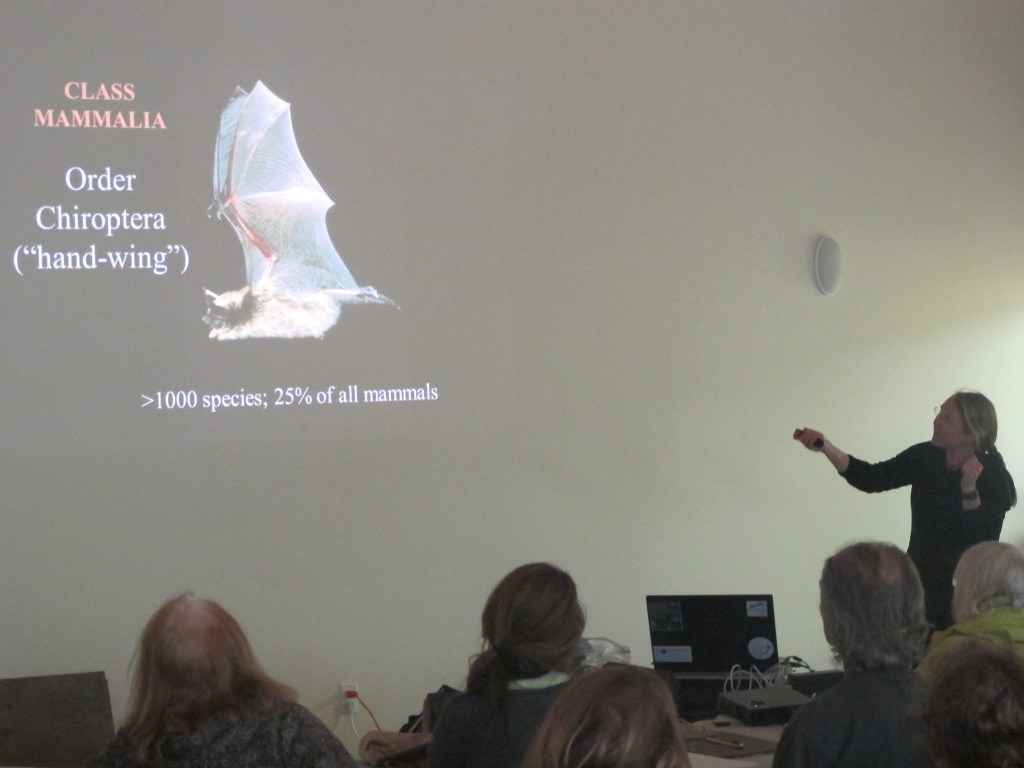
Bats – Dr. Cori Lausen
Chiropterology (Greek cheir – “hand” + pteron – “wing”)
Cori Lausen offered an engaging presentation on bat conservation and the threat of White Nose Syndrome. BC is home to 16 species of bats—Canada’s highest diversity.
Bat Species Observed:
Bonanza Marsh:
- California Myotis (Myotis californicus)
- Yuma Myotis (Myotis yumanensis)
- Little Brown Bat (Myotis lucifugus)
- Long-eared Myotis (Myotis evotis)
- Silver-haired Bat (Lasionycteris noctivagans)
- Long-legged Myotis (Myotis volans)
Hunter Siding Wetland:
- California Myotis (Myotis californicus)
- Yuma Myotis (Myotis yumanensis)
- Little Brown Bat (Myotis lucifugus)
- Long-eared Myotis (Myotis evotis)
- Silver-haired Bat (Lasionycteris noctivagans)

Amphibians – Jakob Dulisse
Herpetology (Greek herpeton – “creeping thing”)
Jakob shared insights into local amphibians and efforts like “ToadFest,” which protects Western Toads (Anaxyrus boreas) from road mortality during migrations.
Amphibian Species Observed:
Hunter Siding Wetland:
- Western Toad (Anaxyrus boreas)
- Columbia Spotted Frog (Rana luteiventris)
- Pacific Tree Frog (Pseudacris regilla)
- Long-toed Salamander (Ambystoma macrodactylum)
Bonanza Marsh:
- Columbia Spotted Frog

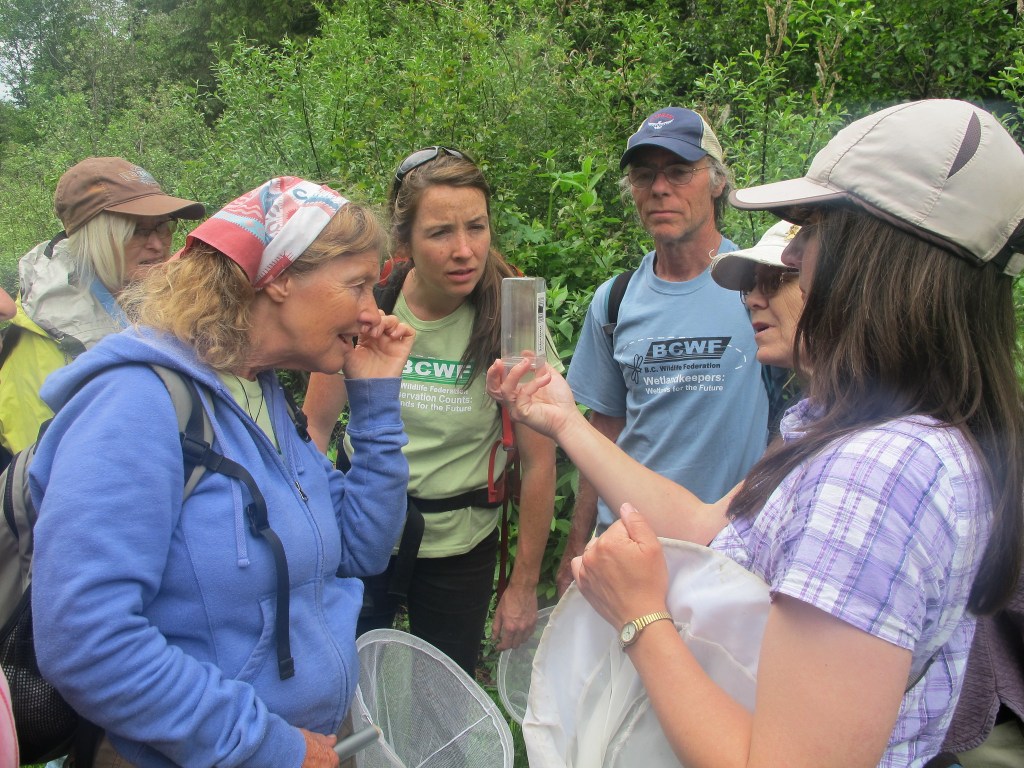
Invertebrates – Peter Wood
Entomology (Greek entomos – “insect”)
Peter Wood guided participants in identifying aquatic invertebrates, a key part of wetland biodiversity and water quality monitoring.
Invertebrate Species Observed:
- Aquatic Crane Fly larva (Family: Tipulidae)
- Dragonfly nymph (Family: Aeshnidae)
- Damselfly nymph (Family: Lestidae)
- Blackfly larva (Family: Simuliidae)
- Water Beetle (Family: Dytiscidae)
- Mayfly larva (Order: Ephemeroptera)
- Leech (Subclass: Hirudinea)
- Snail (Class: Gastropoda)
- Waterboatman (Family: Corixidae)
- Waterstriders (Family: Gerridae)
- Mosquito larva (Family: Culicidae)
- Water Beetle larva (Family: Dytiscidae)
- Stonefly larva (Order: Plecoptera)


Plants – Evan McKenzie
Botany (Greek botane – “pasture, grass, or fodder”)
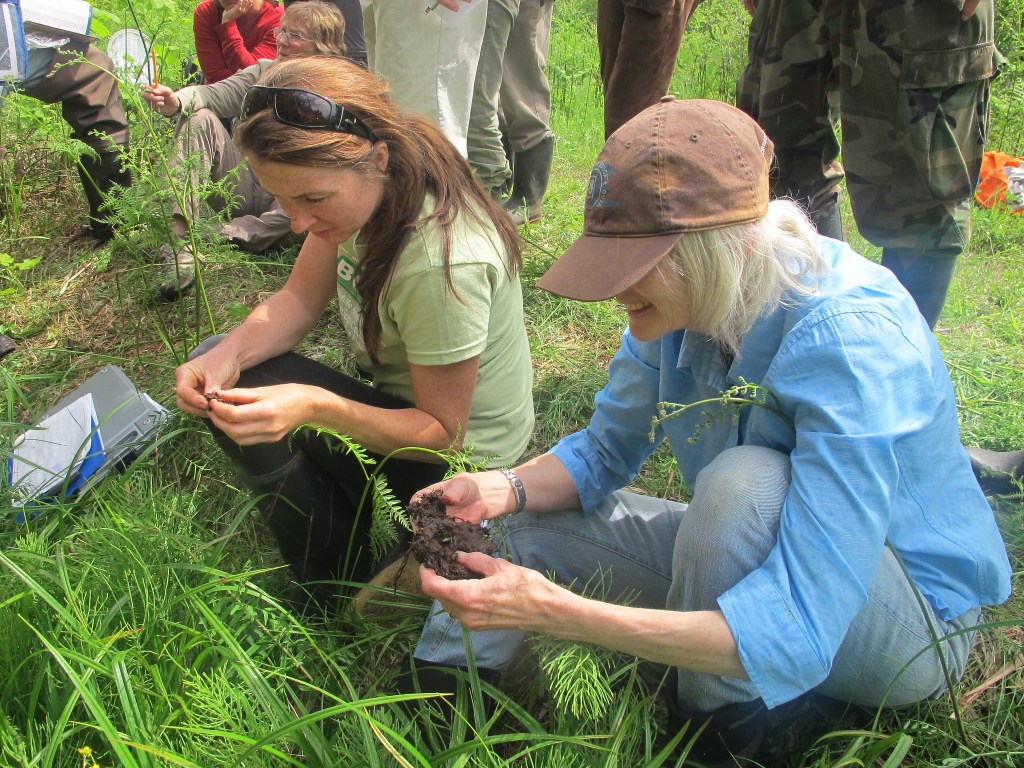
With a hand lens in hand, Evan McKenzie guided plant ID and soil analysis. Over 100 plant species were documented between the two sites.
Plant Species Observed:
- Acer glabrum (Douglas Maple)
- Alnus incana (Sitka Alder)
- Alnus viridis (Green Alder)
- Amelanchier alnifolia (Saskatoon Berry)
- Anaphalis margaritacea (Pearly Everlasting)
- Angelica arguta (Lyall’s Angelica)
- Arctostaphylos uva-ursi (Kinnikinnick)
- Arnica cordifolia (Heart-leaved Arnica)
- Artemisia frigida (Fringed Sagebrush)
- Asarum caudatum (Wild Ginger)
- Aster conspicuus (Showy Aster)
- Athyrium filix-femina (Lady Fern)
- Betula papyrifera (Paper Birch)
- Calamagrostis canadensis (Bluejoint)
- Carex aquatilis (Water Sedge)
- Carex utriculata (Northwest Territory Sedge)
- Cornus sericea (Red-osier Dogwood)
- Equisetum arvense (Field Horsetail)
- Equisetum fluviatile (Water Horsetail)
- Eriophorum angustifolium (Common Cottongrass)
- Fragaria virginiana (Wild Strawberry)
- Galium triflorum (Sweet-scented Bedstraw)
- Geum macrophyllum (Large-leaved Avens)
- Heracleum maximum (Cow Parsnip)
- Iris setosa (Beachhead Iris)
- Juncus balticus (Baltic Rush)
- Linnaea borealis (Twinflower)
- Lonicera involucrata (Black Twinberry)
- Lupinus polyphyllus (Large-leaved Lupine)
- Mentha arvensis (Wild Mint)
- Mertensia paniculata (Tall Lungwort)
- Mimulus guttatus (Common Monkeyflower)
- Osmorhiza chilensis (Sweet Cicely)
- Pedicularis groenlandica (Elephanthead Lousewort)
- Picea engelmannii (Engelmann Spruce)
- Pinus contorta (Lodgepole Pine)
- Populus balsamifera (Balsam Poplar)
- Populus tremuloides (Quaking Aspen)
- Potentilla palustris (Marsh Cinquefoil)
- Ranunculus flammula (Greater Spearwort)
- Rubus idaeus (Red Raspberry)
- Salix bebbiana (Bebb’s Willow)
- Salix discolor (Pussy Willow)
- Salix exigua (Sandbar Willow)
- Salix lucida (Shining Willow)
- Salix scouleriana (Scouler’s Willow)
- Sambucus racemosa (Red Elderberry)
- Sanguisorba officinalis (Great Burnet)
- Scirpus microcarpus (Small-fruited Bulrush)
- Solidago canadensis (Canada Goldenrod)
- Spiraea douglasii (Hardhack)
- Symphoricarpos albus (Common Snowberry)
- Taraxacum officinale (Common Dandelion)
- Typha latifolia (Broadleaf Cattail)
- Vaccinium membranaceum (Mountain Huckleberry)
- Veratrum viride (American False Hellebore)
- Viburnum edule (Highbush Cranberry)

Sensitive Ecosystem Inventory – Ryan Durand
Ryan Durand, founder of Taara Environmental, led GIS mapping and classification to identify fragile ecosystems in the Slocan Valley. Taara also helped develop a management plan for the Daphne Ogilvie Nature Reserve.
CABIN Protocol – Jennifer Yeow & Verena Shaw
CABIN – Canadian Aquatic Biomonitoring Network
Jennifer Yeow and Verena Shaw trained participants in aquatic invertebrate sampling using the national CABIN protocol, which assesses freshwater ecosystem health.


Funders & Partners
This event was made possible thanks to the generous support and collaboration of the following organizations:
- Columbia Basin Trust
- Fish & Wildlife Compensation Program
- Real Estate Foundation of British Columbia
- Shell Canada
- Wildlife Habitat Canada
- Government of British Columbia
- Habitat Conservation Trust Foundation
- Slocan Lake Stewardship Society
- Slocan Lake Research Centre
- Slocan River Streamkeepers
Special Thanks
To Irene Manley (Fish & Wildlife Compensation Program), Margaret Hartley (Slocan Lake Stewardship Society), Richard Johnson (Slocan Lake Research Centre), Marcy Mahr (Know Your Watershed), the Hills Community & Fire Hall, David DeRosa (Teck Resources Limited), and all participants—thank you for making this an outstanding workshop. We look forward to staying connected in your future wetland stewardship journeys!
 BCWF Watershed Team
Leave a comment