
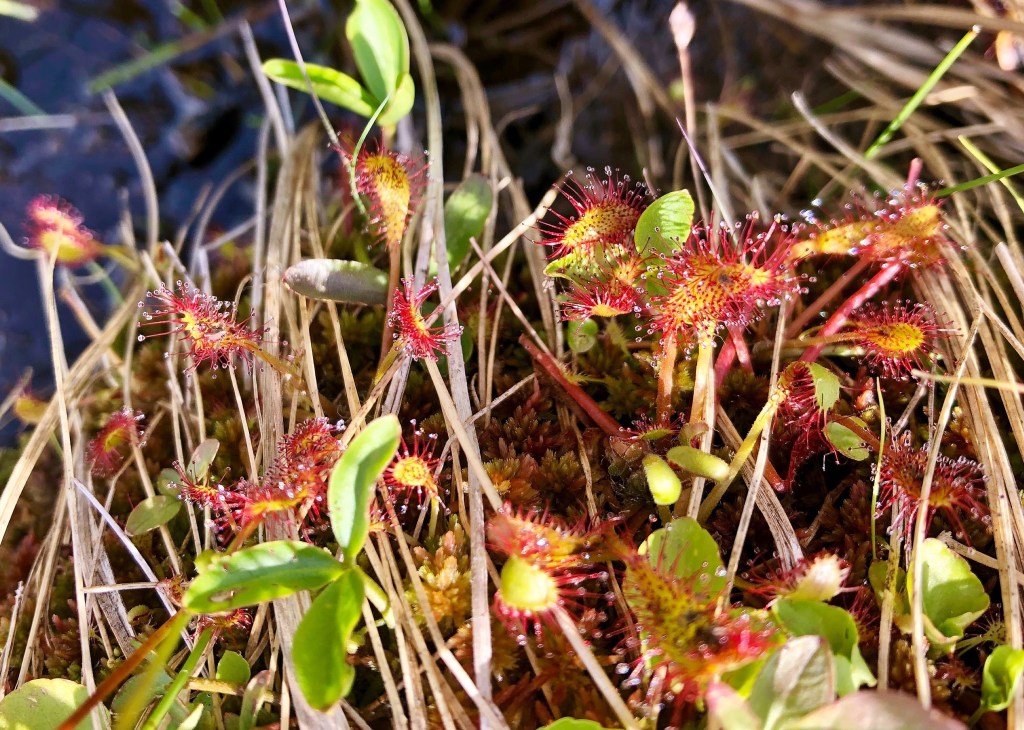
For those who grew up with a Venus flytrap on the windowsill, the BogBlog’s first-ever plant feature in the Species Profile series may spark a familiar fascination—the insectivorous round-leaved sundew!
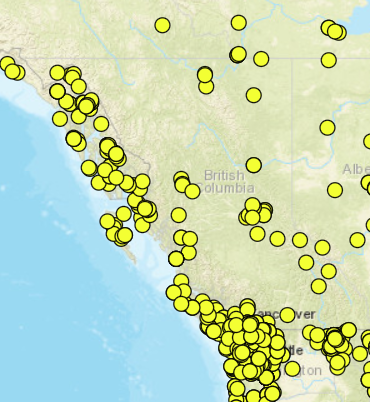
Round-leaved sundew (Drosera rotundifolia) is found widely across the circumboreal region of the northern hemisphere. Common throughout British Columbia, these voracious little plants can often be spotted in local wetlands. Typically, sundews thrive in marshes, bogs, fens, sphagnum beds, and similar wet habitats with high sun exposure.
This small but mighty plant grows just 3–5 cm in diameter and 5–25 cm tall. Each stem ends in a round leaf blade about 6–12 mm wide, covered in upward-facing red hairs that secrete a sticky, insect-trapping fluid. Its pink or white flowers grow on long stems that rise above the leaf cluster—cleverly keeping pollinators safe from the sticky hairs below.
Sundews evolved their carnivorous habits to supplement nutrients lacking in their native soils. The red hairs on their leaves attract and digest insects, providing essential nitrogen in the form of ammonia. Known prey includes mosquitoes, gnats, and even small moths.
Beyond their fascinating feeding strategy, round-leaved sundews are strikingly beautiful. Their crimson hairs glisten with dew-like droplets, offering a brilliant contrast against the earthy wetland backdrop. These plants also hold cultural and medicinal significance. The Haida referred to sundew as “many hearts,” using it as a fishing good luck charm. In homeopathy, sundew has been used as an anti-inflammatory, an antispasmodic chest relaxant, and a topical treatment for warts.
Round-leaved sundew often shares its boggy, acidic habitat with other wetland specialists such as sphagnum moss, pitcher plants, Labrador tea, cotton grass, bog laurel, and bog orchids. These species are all uniquely adapted to thrive in the nutrient-poor, water-saturated conditions of B.C.’s marshes, bogs, and fens.
Families exploring local wetlands might enjoy seeking out sundews as part of outdoor adventures. These tiny hunters can spark curiosity in young nature explorers—and even help control the occasional fruit fly infestation at home.
 BCWF Watershed Team
Leave a comment