
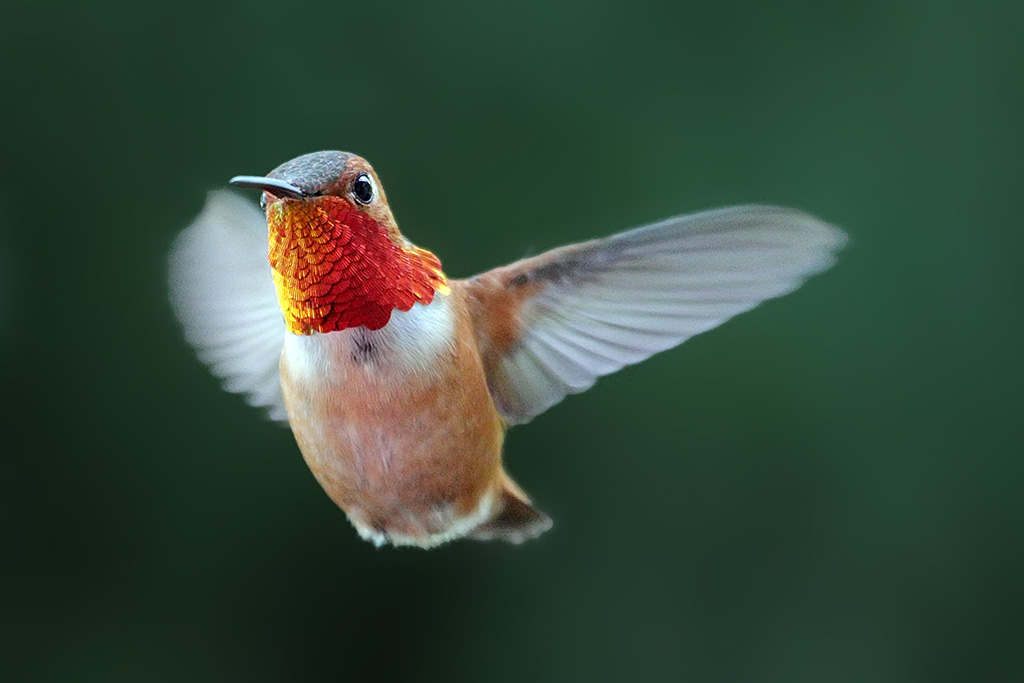
Ah, the Rufous Hummingbird—a common yet seemingly rare bird that captures our attention and makes us stare in awe at its fiery feathers and futuristic flight. Their flight pattern is mesmerizing, darting and hovering in a way that resembles something like a spaceship. Given their status as such a captivating creature, let’s take a closer look at how they interact with wetlands.
The Rufous Hummingbird (Selasphorus rufus) ranges from southern Alaska all the way to Central America. They breed in open areas, parks, yards, and forests up to the treeline, and during migration, they’ll visit high-altitude meadows—sometimes as high as 12,000 feet—where nectar-rich flowers bloom. In winter, they migrate to Mexico, where they inhabit oak-pine forests and shrubby landscapes.
While often associated with nectar, these hummingbirds also rely heavily on insects for protein. If you’re trying to identify a Rufous Hummingbird, think orange:
- Males have bright orange backs and bellies with a vivid red throat.
- Females are mostly green, with rufous patches in the tail and a touch of orange in the throat.
In British Columbia, wetlands offer great opportunities to spot them, thanks to the abundance of insects and nectar-producing plants like salmonberries, penstemons, lilies, fireweeds, ribes, and heaths.
Where to See Them and How to Attract Them
If you live in Metro Vancouver, try hiking Hollyburn Mountain in late summer—when blackberries are ripe, the hummingbirds are likely nearby. Want to attract them at home? Set up a hummingbird feeder using a simple nectar solution: boil 1 cup of white sugar with 4 cups of water for 2 minutes, then cool and fill your feeder. Just be aware that hummingbirds are solitary and fiercely territorial, so you’re unlikely to see more than one at a time. Rufous Hummingbirds, in particular, are known for their feisty nature and will aggressively defend their food sources.
Fast Facts to Impress Your Friends
- The Rufous Hummingbird makes one of the longest migratory journeys of any bird in the world relative to its size. Its 6,300 km migration is equivalent to nearly 80 million body lengths (they’re only about 3 inches long).
- Their wings beat 52 to 62 times per second, enabling them to hover with incredible precision.
Now that you’re hummingbird-wise, you might just win your next trivia game—or at least inspire a few more nature walks.
Thank you to Flickr member, Brian Hampson, for snapping the incredible photo that inspired this post!
 BCWF Watershed Team
Leave a comment