
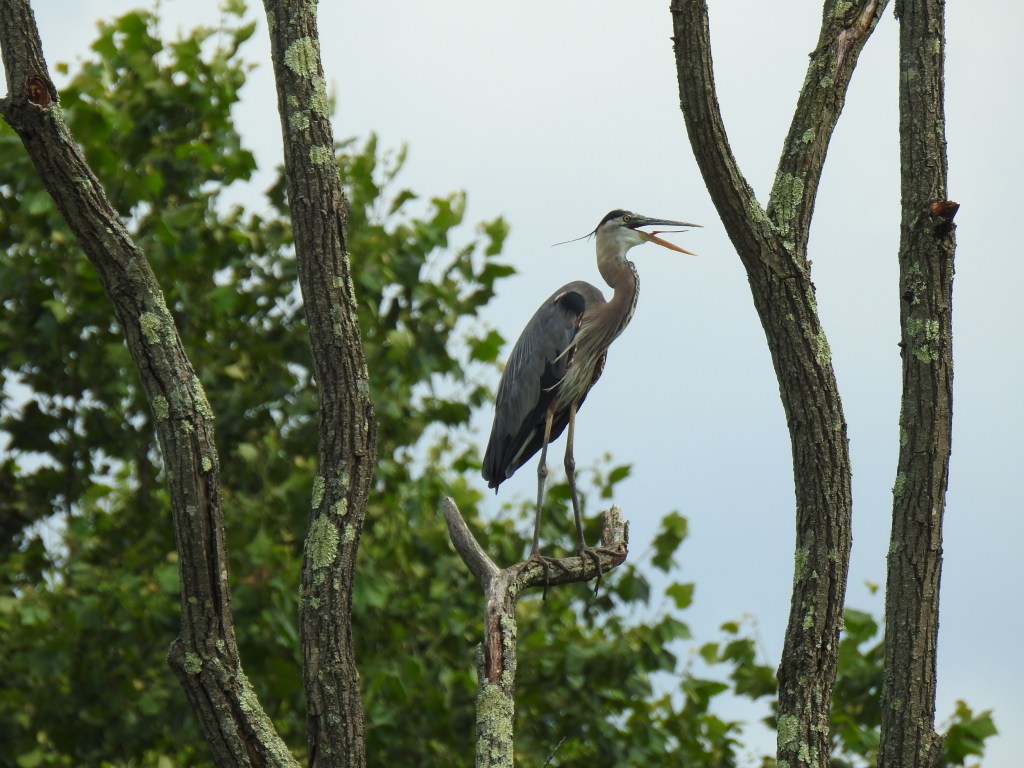
Given how common they are around wetlands, it only makes sense to learn a bit about them. That way, the next time someone points one out, you’ll be able to rattle off a few fun facts and earn the title of Heron Expert—because really, who doesn’t want that?
In British Columbia, two subspecies of Great Blue Heron can be observed: the Ardea herodias subspecies, found more commonly inland, and the Ardea herodias fannini subspecies, which resides along the coast. Both are part of a larger range that stretches across most of North and Central America.
Great Blue Herons are large wading birds typically seen near wetlands and shorelines. To be blunt: these birds are massive. They can reach up to 138 cm tall, with an impressive wingspan of 201 cm. Yet despite their size, they weigh only up to 7.9 lbs—showing just how perfectly adapted they are for flight. If their size doesn’t give them away, look for these distinctive features: a rusty-gray neck, red-brown thighs, a dull yellow-orange bill, and a mostly white face. Or, if you’re near water and spot a bird flying by with a wingspan rivaling that of a pterodactyl, chances are good it’s a Great Blue Heron.
These birds are known for their harsh croaking call, which you can hear here. They are incredibly adaptable and can thrive in nearly any wetland environment. Common habitats include freshwater and saltwater marshes, mangrove swamps, flooded meadows, lake shores, and even urban areas—so long as there’s a body of water with fish. If you’re hoping to spot one while birdwatching, check for nests in trees near the water’s edge. They often choose islands for the added seclusion.
Despite their intimidating stature, there’s no need to worry—they won’t eat you. Their diet consists mainly of small fish, though they’ll also go after shrimp, crabs, insects, rodents, and small amphibians when fish are scarce. Because they swallow prey whole, their meals tend to be modest in size. Herons typically forage in shallow waters under 50 cm deep—another reason they love wetlands.
If you’re hoping to see one in action, you’re in luck—just visit your local wetlands. Great Blue Herons are especially vocal during their breeding season, which runs from March to May, so spring is a great time to catch a glimpse (or hear that unmistakable croak).
All that’s left to do is get outside, visit your wetlands, and appreciate the habitats they provide—especially for these larger-than-pterodactyl birds.
Note: Both the herodias and fannini subspecies of Great Blue Heron are listed on B.C.’s Blue List and are considered species of special concern.
 BCWF Watershed Team
Leave a comment