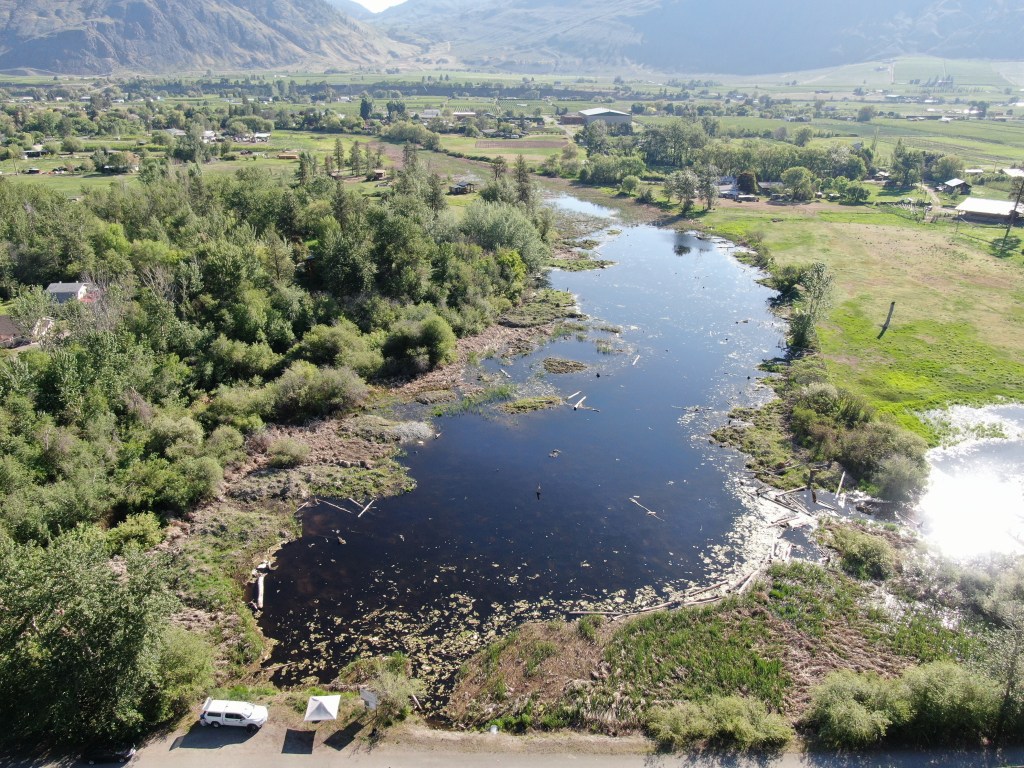
As much as 85% of wetlands have been lost in the Okanagan and Similkameen region. Given the heavy dependency on water conservation in farming communities like Cawston, BC—known as the Organic Capital of Canada—the opportunity to restore Ginty’s Pond (nʔaʕx̌ʷt) back to an open water wetland was a clear choice for Josie Symonds, a senior biologist with the Province of BC.
The historical nʔaʕx̌ʷt wetland is located in Cawston, within the territory of the Smelqmix people of the Sylix Nation. The nʔaʕx̌ʷt wetland was historically an oxbow pond of the Similkameen River.
After high levels of modification due to the development of agriculture that spans the Similkameen Valley, Ginty’s Pond has been largely altered. Today, the nʔaʕx̌ʷt wetland is spring-fed and mostly disconnected from the river aside from a surface connection at the southern end.
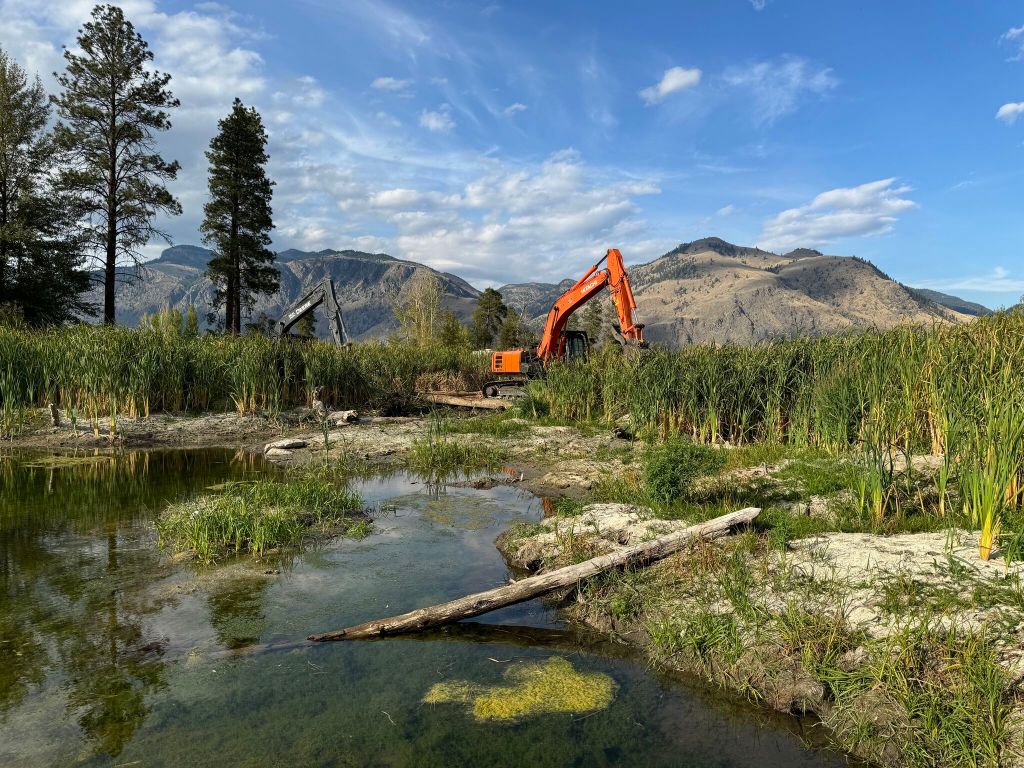
In the fall of 2022, Ginty’s Pond saw its first major restoration efforts. To begin the project, Josie had to overcome many hurdles including nearby wildfires, an atmospheric river event, a global pandemic, and funding challenges.
“This project was a big undertaking,” Josie reflects, “but I started off by simply asking myself, ‘What if I said yes?’”
Recognizing the need for specialized wetland knowledge, Josie sought guidance from experts. “I am not a wetland specialist, so I had to call on others for help,” Josie shared.
“My first call was to Neil Fletcher of the B.C. Wildlife Federation. Fortunately, I had participated in the BCWF’s Wetlands Institute in the past, and Neil informed me that funding was available for projects led by past participants.”
In 2019, the BCWF led a Wetlandkeepers Workshop in Cawston, focusing on the historical and present value of Ginty’s Pond, potential restoration methods, and community concerns. This workshop revealed strong community interest in the site’s restoration.
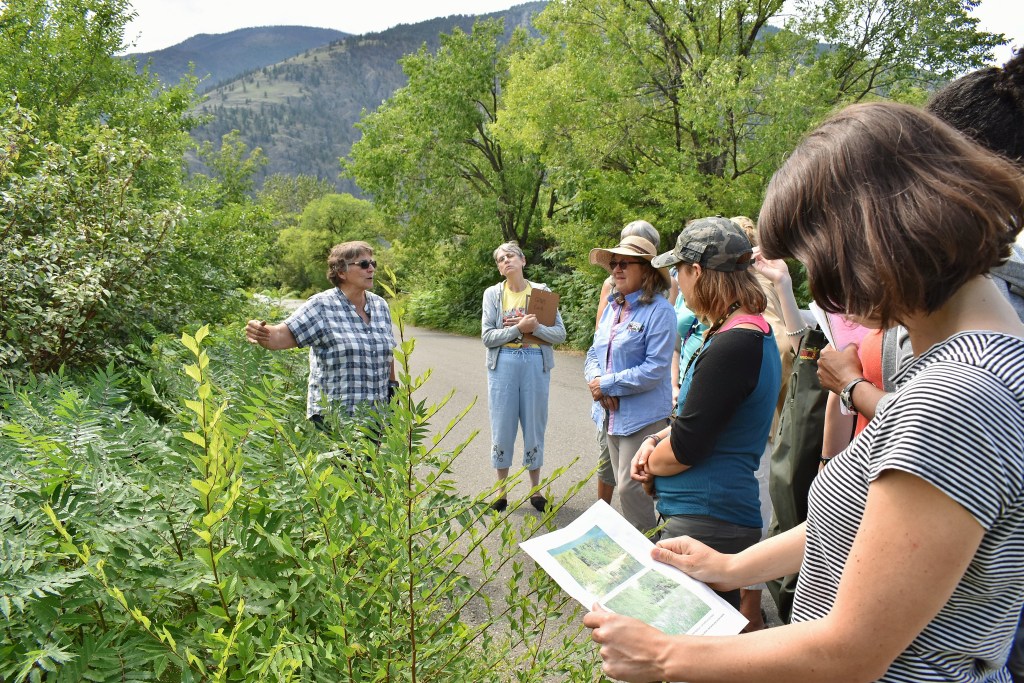
Community interest was centered around two factors, which contributed to the project’s early goals:
- Water Storage and Conservation: Made up of mostly farmers, Cawston relies on a healthy and available groundwater supply that can support agriculture throughout the village.
- Cultural Uses: Historically, the site was a community asset for activities like skating and kayaking—activities that the community wished to carry onward for generations to come.
With these goals in mind, the initial stages of the wetland restoration project began.
“To start, we focused on assessing biological impacts and benefits,” said Josie. “Prior to restoration, the wetland was dominated by cattails with some invasive Yellow Flag Iris, which limited habitat diversity.”
Early steps toward this project’s success involved conducting a plant and wildlife inventory, setting minnow traps, and conducting drone assessments. These measures helped Josie to identify species utilizing the site and confirmed the presence of fish in the pond.
“Upon observing no significant problems, planning began,” Josie shared. “Funding was initially a barrier, but the project partners eventually secured support.”
Results
Phase one of the nʔaʕx̌ʷt wetland restoration project aimed to expand open water habitats, improve conditions for aquatic life, and increase community resilience to fires, floods, and droughts. This phase resulted in two acres of restored habitat, with 1.2 hectares deepened to create pools and 0.8 hectares restored to healthy riparian habitat. A total of 1,700 trees and shrubs were planted, and 0.8 hectares of ground cover were seeded. Additionally, with support from the Nature Trust of BC, 500 meters of new fencing were installed to protect the restored habitat from livestock. Turtle nesting areas, basking logs, and coarse woody debris were added to enhance habitat complexity.
“Through this project’s first phase, I was reminded of the importance of networking,” said Josie. “These projects are seldom solo endeavors and often require the collaboration of various partners. Considering the people on the team and making the project enjoyable are also vital components. It’s important to celebrate successes along the way, both big and small.”
“The journey of restoring Ginty’s Pond has been a source of numerous insights and lessons learned,” Josie reflected. “On-the-ground restoration projects are a lot of hard work, but worth it.”
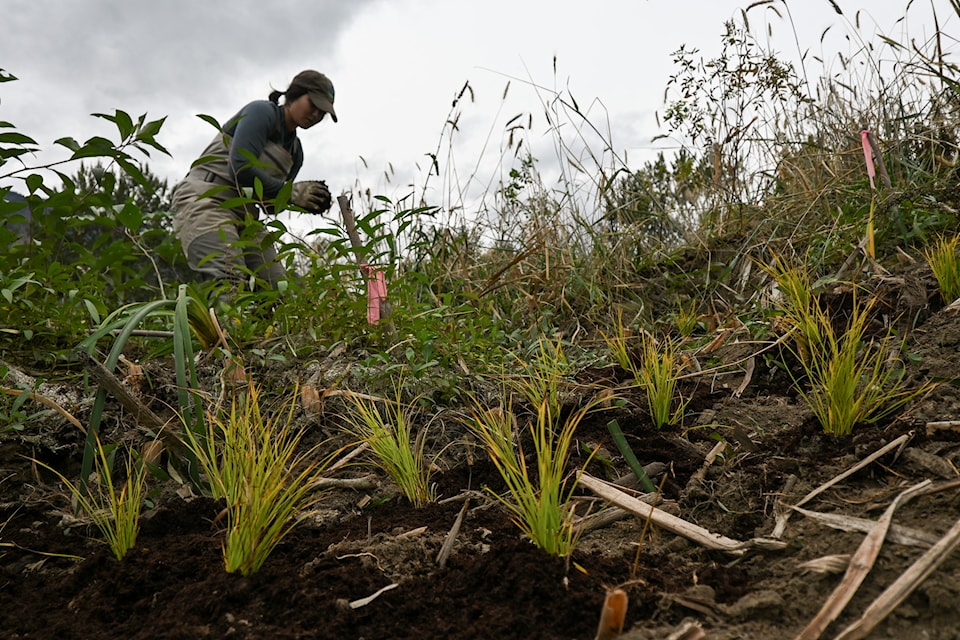
A keystone of the project’s first phase was the collaboration with partners, each offering essential support in various aspects. The Ministry of Water, Land, and Resource Stewardship (Province of BC) supplied a project manager (Josie), permitting expertise, funding, and networking opportunities. The Southern Interior Land Trust (SILT) served as the project coordinator, treasurer, and landowner. The Lower Similkameen Indian Band provided Indigenous and cultural insights, along with environmental monitoring and equipment operation. The B.C. Wildlife Federation (BCWF) contributed wetland expertise, funding, workforce, PR, and correspondence. Additionally, through the BCWF, Rewilding Water and Earth created and directed the restoration design for the nʔaʕx̌ʷt wetland project.
What’s Next for nʔaʕx̌ʷt?
This September (2024), Ginty’s Pond begun its second phase, which is focused on creating an additional two hectares of open-water habitat and 0.5 hectares of upland riparian habitat, featuring species such as cottonwood, woods rose, red osier dogwood, and milkweed—all of which have successfully taken root in the Phase One area. Other focuses for the second phase of this project include a strong focus on outreach by involving local schools and nearby First Nations in the site’s monitoring and restoration.
We extend our gratitude to the Community Foundation South Okanagan and the Watershed Security Fund for supporting this project in 2024.
More About Ginty’s Pond
Ginty’s Pond, also known to the community as the Cawston Slough, was once owned by Ginty Cawston, an early farmer who settled in the area and enjoyed the pond and its wildlife. Later, the Southern Interior Land Trust (SILT) purchased the property. At the request of Cawston’s family, the pond was named Ginty’s Pond when SILT acquired it.
 BCWF Watershed Team
Leave a comment