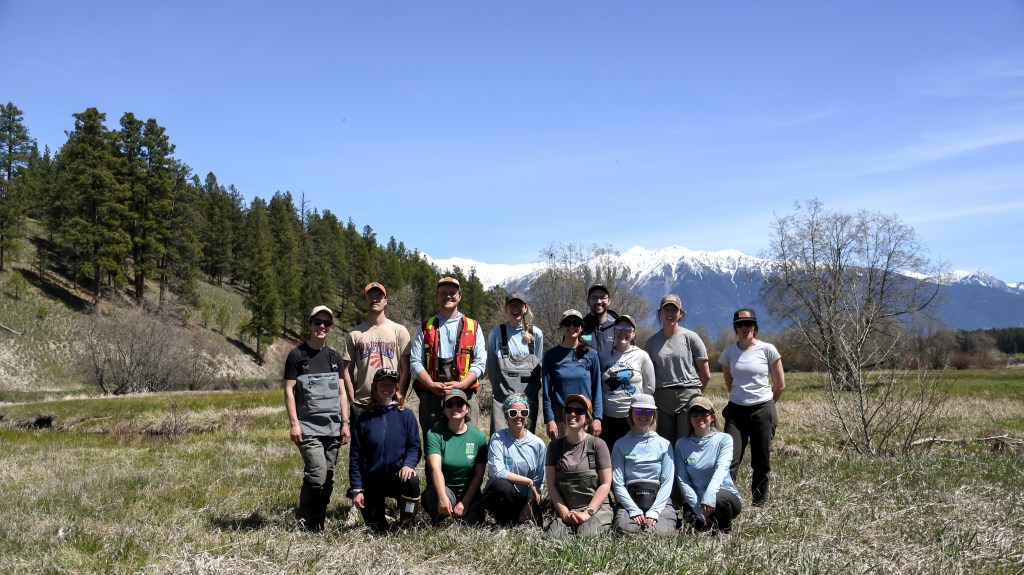
The Watershed Team is the B.C. Wildlife Federation’s most impactful boots-on-the-ground conservation initiative.
The B.C. Wildlife Federation’s Watershed Team began with a simple but powerful idea: Education leads to action.
In 1996, the BCWF launched the Wetlands Education Program (WEP) in response to the rapid loss of wetlands in British Columbia. The goal was to raise awareness, foster stewardship, and provide British Columbians with the knowledge and tools to protect these vital ecosystems. Early program leaders helped establish long-standing initiatives like Wetlandkeepers and the Wetlands Institute, laying the foundation for what, years later, would become a province-wide team of wetland restoration professionals.
In 2010, our education foundation expanded into fieldwork. With restoration projects beginning to take shape on the ground, the BCWF shifted from education alone to active habitat enhancement. That same year, Neil Fletcher joined the team as a WEP intern. Today, he serves as the BCWF’s Director of Conservation Stewardship and has guided the organization’s watershed initiatives for over 14 years.
In 2021, the team launched its most ambitious initiative yet: the Wetlands Workforce (WW). Funded through the Healthy Watersheds Initiative—delivered by the Real Estate Foundation of BC and Watersheds BC with support from the Province of British Columbia as part of its COVID-19 economic recovery plan—the project marked one of the largest collaborative wetland efforts in the province’s history.
The Wetlands Workforce brought together eight partner organizations and engaged over 45 First Nations to deliver on-the-ground restoration, monitoring, and stewardship across B.C. Partners included Ducks Unlimited Canada, Langley Environmental Partners Society, The Nature Conservancy of Canada, The Nature Trust of BC, Wildcoast Ecological Society, Fraser Valley Watershed Coalition, and Yaqan Nukiy First Nation (Lower Kootenay Band).
The WW project was catalyzed by a significant $5-million grant from the Healthy Watersheds Initiative. This initiative, part of a broader $27-million project supported by the Province of British Columbia, aimed to stimulate economic recovery post-COVID-19 through investments in community driven watershed conservation and restoration projects.
In 2021 alone, the Wetlands Workforce conducted restoration, enhancement, maintenance, and monitoring work for 221 wetland sites across British Columbia in four Eco-Provinces: Boreal and Taiga Plains, Georgia Depression, Southern Interior Mountains, and Sub-boreal Interior.
The innovative Wetland Ecosystem Services Protocol (WESP) tool, led by Kyla Rushton, BCWF’s Wetland Assessment and Field Coordinator, was introduced to B.C. to build a catalog of hundreds of wetlands—identifying those that are most productive and those most in need of protection and restoration.
Other resources developed throughout the Wetlands Workforce project have included the Wetland Plants of BC—a field guide to indicator species for wetland classification, and Chenoa Gao’s graphic novel, We Are of Water—a series of graphics celebrating the communities that supported wetland restoration work and promoting reconciliation.
During the Wetlands Workforce project, Indigenous Advisors Diana Cote and the late Glenn Auger played crucial roles in guiding staff to build respectful and mutually beneficial relationships with First Nations communities—lessons that our field crews and current Indigenous Liaison, Taylor Sounding Stone, continue to carry forward today.
Thanks to an additional $5.5 million in Watershed Security funding from the Province of British Columbia over 3 years (2022 to 2024), the BCWF’s Wetlands Workforce project expanded and morphed into the multi-faceted Watershed Team, providing essential employment, promoting research and science, and contributing to the enhancement, maintenance, and restoration of wetlands, streams and riparian zones across the province.
Where We Are Today
Since those early days, the B.C. Wildlife Federation has assessed hundreds of wetlands and restored or enhanced hundreds of hectares of wetland and stream habitat across the province. What began as a small team of fewer than five has grown into a dynamic group of over 20 full-time staff—mostly women—working year-round to protect and restore wetlands and watersheds.
Under the leadership of Neil Fletcher, the Watershed Team continues to collaborate with First Nations, conservation organizations, and local communities to improve habitat, strengthen watershed security, and engage the public through education and stewardship. This work is the result of years of dedication, meaningful partnerships, and a shared commitment to protecting the lands and waters that sustain us all.
Today, building on the legacy of the Wetlands Workforce and the foundations laid by the Wetlands Education Program, the BCWF’s Conservation Stewardship field crews and staff are collectively known as the Watershed Team. With a clear focus on protecting and promoting wetland and watershed habitats, the team operates through three core program areas: Restoration Projects, Conservation Tools, and Education Programs.
Through each of these pillars, the Watershed Team is dedicated to conserving water and healthy ecosystems for the benefit of future generations. Central to this work is a continued commitment to engaging with First Nations and Indigenous-led organizations across the province. The B.C. Wildlife Federation expresses deep gratitude for the relationships and knowledge shared by the many Indigenous communities we have had the honour of working alongside—and continue to work with today.
- Restoration Projects
- The BCWF’s Watershed Team actively engages in innovative and collaborative ecological restoration, including our newest initiative, the 10,000 Wetlands Project, which uses beaver-based restoration to enhance watershed resilience. The Watershed Team is also committed to on-the-ground wetland and stream restoration, encompassing monitoring, maintenance, education, and knowledge-sharing to ensure a healthier environment for future generations.
- Conservation Tools
- The BCWF’s Watershed Team is developing and utilizing various advanced conservation tools in partnership with organizations across British Columbia . Key initiatives include the Wetland Ecosystem Services Protocol (WESP) for standardizing wetland function assessments, the Canadian National Wetlands Inventory (CNWI), and the digital plant guide Wetland Plants of BC for wetland classification. We are currently working on version three and hope to have a print version available soon.
- Education Programs
- Through our education programs, the BCWF’s Watershed Team is enhancing grassroots, community-driven conservation efforts and promoting watershed health across the province. Education programs like the Wetlands Education Program (WEP) and the Fish Habitat Restoration and Education Program (FHREP) offer educational courses, workshops, and outreach events focused on equipping local communities with the knowledge and tools to better understand and steward their natural environments.
The B.C. Wildlife Federation’s Watershed Team has come a long way—from education to restoration, from a small crew to a province-wide force for conservation. Guided by community, science, and strong partnerships, we’re proud to continue this essential work for the health of B.C.’s wetlands, watersheds, and future generations.
To find more information about our Watershed Team including historic information about what we’ve accomplished as well as up-to-date information on the team’s initiatives, be sure to subscribe to our new website www.bcwfwatershedteam.ca and follow our Facebook page, B.C. Wildlife Federation’s Watershed Team (formerly the B.C. Wildlife Federation’s Wetlands Education Program Facebook page).
Subscribe to the BCWF’s Watershed Team Mailing List:
Thank you to Monica Pearson for coining the name 10,000 Wetlands Project.
 BCWF Watershed Team
Leave a comment