As the B.C. Wildlife Federation prepares for its upcoming 2023 Wetlands Institute, we are inspired to look back on the transformative journeys of past participants. Among them is the heartwarming story of Susan DeBeck, who attended the program in 2021.
While many come to the Institute with backgrounds in environmental science, Susan stands out as a prime example of passion and individual initiative. Primarily an early childhood educator, she undertook an ambitious project to restore her Galiano Island backyard to its native roots.
Half of Susan’s one-acre property—where she has lived for nearly a decade—is wetland. However, a significant portion of it had been overtaken by invasive reed canarygrass (Phalaris arundinacea) and other non-native species. Susan enrolled in the 2021 Wetlands Institute, held across the Comox Valley, Denman Island, and Galiano Island, and used the knowledge and resources gained in the workshop to begin reclaiming her land.
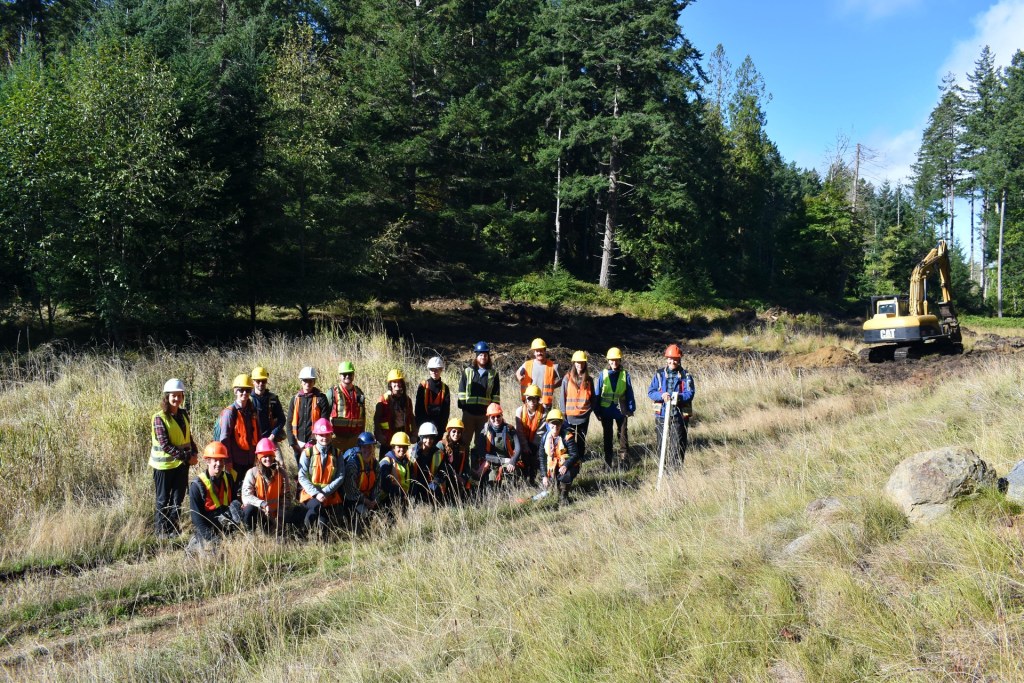
During the Institute, Susan participated in both classroom and hands-on learning focused on the planning, design, and restoration of wetlands. The insights she gained empowered her to pursue her vision of restoring the wetland on her property, despite the challenges posed by reed canary grass. She also developed a deeper understanding of the ecological importance of wetlands—knowledge that fueled her motivation to continue the restoration work long after the program ended.
Later, BCWF staff had the opportunity to visit Susan’s property and helped her clarify her objective: to create a wetland meadow, rather than a wetland forest.
To support her project, Susan has collaborated with a number of restoration experts, including Kristen Miskelly from Satinflower Nursery in Saanich. With extensive experience in native plant and wetland restoration, Kristen agreed to consult on the project. Under her guidance, Susan has been methodically suppressing invasive species by covering them with plastic. After several months, she removes the plastic and plants a variety of native species tailored to her site based on Kristen’s recommendations.
As of 2023, Susan continues to update us on her restoration journey.
“I am making slow progress on my wetland, and it is very satisfying to see the reed canary grass being replaced by native species. As you can see in the lupin photo, a considerable area is still covered with plastic, but progress is being made,” Susan shared.
This fall, she plans to introduce more aquatic vegetation into the pond area to create a more hospitable environment for native frogs.
As we prepare for the next Wetlands Institute, stories like Susan’s remind us of the diverse paths our participants take—and the real difference this program can make when knowledge, community, and passion align.
About the Wetlands Institute
Organized by the B.C. Wildlife Federation’s Wetlands Education Program (WEP), the Wetlands Institute is an intensive, week-long workshop designed for individuals looking to lead wetland and watershed restoration efforts in their communities. Valued at over $1,000, this training is available at no cost to eligible B.C. residents thanks to the generous support of program funders, including the Province of British Columbia, Wildlife Habitat Canada, the Habitat Conservation Trust Foundation, BC Interior Community Foundation, and proceeds from the BCWF lottery.
Participants receive in-depth training in wetland planning, restoration, and monitoring. Each year, the program takes place in a different host community and is tailored to reflect local ecological priorities, expert knowledge, and Indigenous perspectives.
 BCWF Watershed Team
Leave a comment